


What If AI Didn't Need to Write an Answer?
What if the next evolution of AI isn't about generating better answers, but making better decisions?
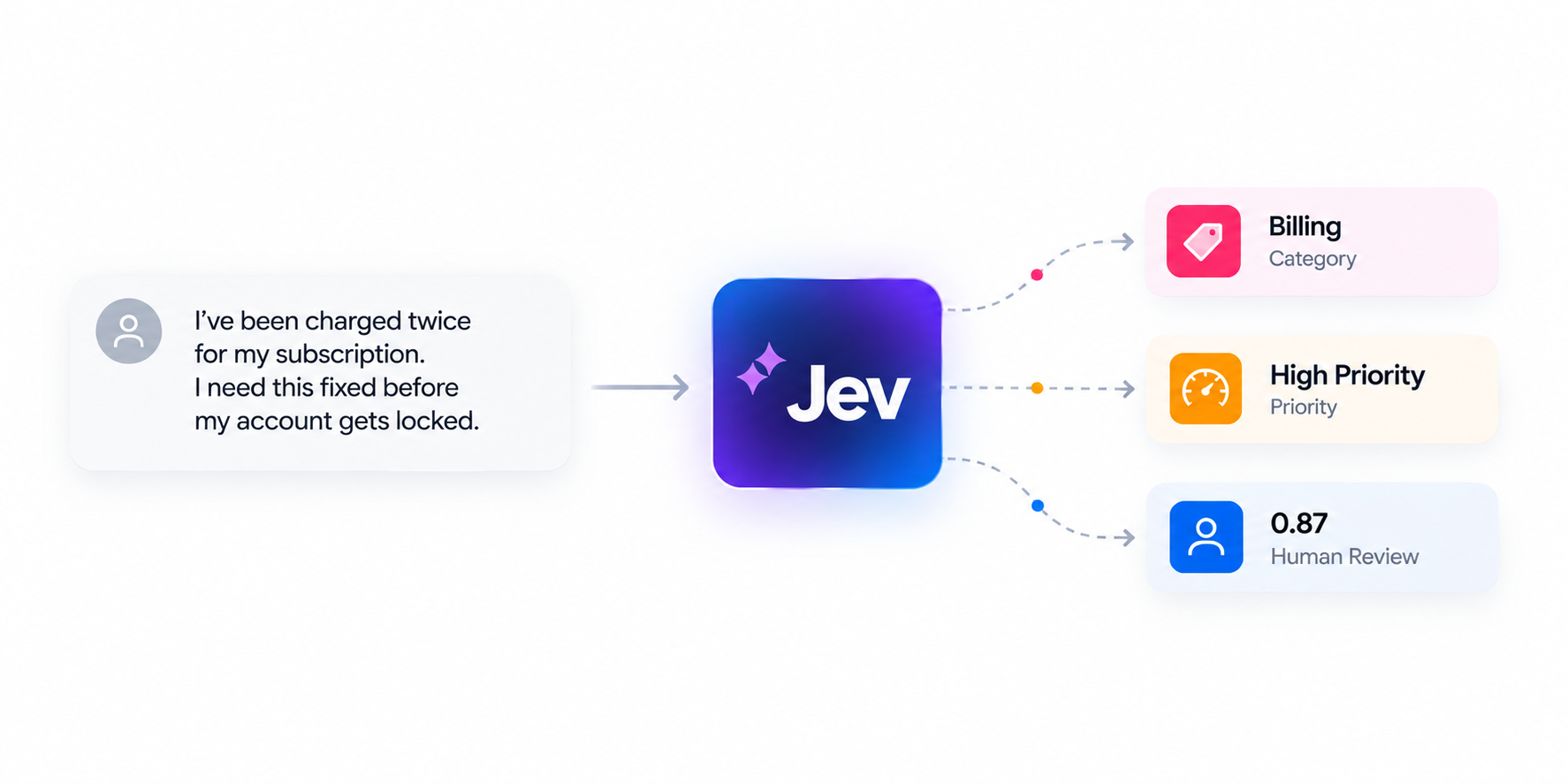
Imagine an AI-powered customer support system receiving this message:
"I've been charged twice for my subscription. I need this fixed before my account gets locked."
The application needs to figure out what happens next. Is this a billing issue? How urgent is it? Should it be handled automatically or sent to a human?
Today, the obvious answer is to send the message to a Large Language Model (LLM). The model understands the request, reasons about it, and generates a response.
But does the application really need a paragraph?
Probably not.
It may simply need:
Billing. High Priority. Human Review.
That difference is small on the surface, but it points to an interesting shift in how we think about AI.
We Use LLMs for Almost Everything
Large language models have become incredibly versatile. They can write emails, summarize documents, generate code, answer questions, and understand complex conversations.
Naturally, we've started using them for almost every AI task—including tasks where the final output isn't meant for a human at all.
Consider a support ticket. If the application only needs to know whether the ticket belongs to Sales, Billing, or Technical Support, generating a detailed explanation isn't necessarily the goal.
The software needs a decision it can act on.
This creates a simple question:
What if AI didn't always need to generate an answer? What if it simply needed to decide?
Enter Jev
This is where Jev, developed by TypeSafe AI, becomes interesting.
Introduced in September 2026 as TypeSafe's first System One model, Jev is designed around structured decision-making rather than traditional free-form text generation. Instead of asking the model to produce an explanation, developers can give it information about a situation and ask a focused question that the application needs answered.
Think of the difference like this:
Traditional AI:
Input → Generate → Interpret → Act
Decision-oriented AI:
Input → Decide → Act
For example, an application could ask:
“Which team should handle this request?”
The possible choices might be Sales, Billing, or Technical Support.
The output can then become part of the application's workflow.
No unnecessary paragraph. No additional interpretation layer. Just a structured decision.
Different AI Models, Different Jobs
This doesn't mean Jev is intended to replace LLMs.
In fact, the more interesting possibility is that they work together.
An LLM can understand a customer's message and generate a natural response. A decision model can determine where the request should go, whether it requires escalation, or whether a generated response should be accepted.
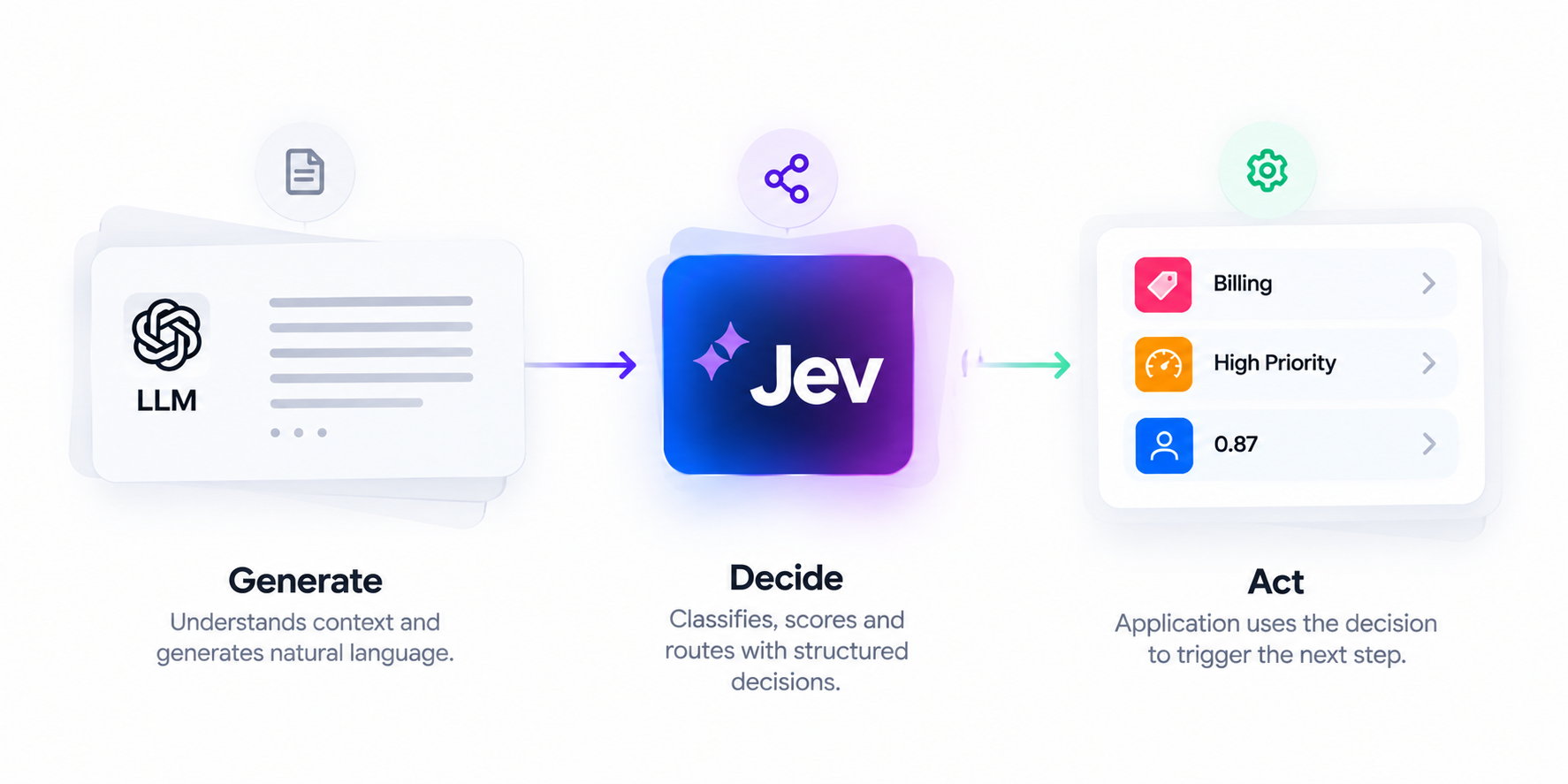
Traditional software can then handle the deterministic parts of the workflow.
This creates a more specialized AI architecture:
LLM → Generate and explain
Decision model → Classify, score and route
Software → Execute rules and actions
The idea isn't to find one model that does everything. It's to use the right kind of intelligence for each part of the system.
Why Structured Decisions Matter
TypeSafe describes Jev around three types of decisions: Choice, Score and Noul. Choice can be used when the system needs to select from defined alternatives. Score provides an ordered assessment, while Noul represents a yes/no decision through a probability.
That probability can be particularly useful in real applications.
Imagine an AI system deciding whether a customer request needs human intervention. Instead of returning only “Yes” or “No,” it could provide a probability.
The application can then define its own rules—for example, automatically handling high-confidence cases while sending uncertain cases to a human reviewer.
This creates an important separation:
The AI provides the judgment. The application controls the action.
That distinction can become valuable as AI systems become more deeply integrated into business workflows.
The Bigger Opportunity: AI Agents
The idea becomes even more interesting when we look at AI agents.
Agents constantly make decisions.
Which tool should they use? Should they continue? Should they retry? Should they ask the user for more information? Should they escalate the task?
These aren't necessarily generation problems. They are decision problems.
As AI agents become more sophisticated, specialized decision models could become another component in the agent architecture—helping determine what should happen next while generative models focus on understanding, planning and communication.
The result could be a system where AI isn't just generating content, but actively controlling workflows through structured decisions.
The Future May Not Be One Giant AI Model
For years, the AI conversation has focused on bigger and more capable models.
But perhaps the next step isn't simply making one model do everything.
It could be about building systems where different models perform different jobs.
Use an LLM when you need language. Use retrieval when you need information. Use traditional code when the answer is deterministic. And when the application needs a structured judgment, use a model designed for that purpose.
Jev is an interesting example of this direction.
The bigger question isn't whether decision models will replace LLMs. It's whether AI applications will increasingly become systems of specialized intelligence, with each model handling the type of problem it is designed to solve.
Because sometimes AI doesn't need to write a paragraph.
Sometimes the software just needs an answer:
Yes. No. 0.87. Route to Billing. Escalate. Continue.
And that may be an important next step in how we build AI-powered software.