


AI-Assisted vs. AI-Driven Testing in 2026: Choosing the Right AI Strategy for Modern QA
Artificial Intelligence is revolutionizing software testing, enabling QA teams to deliver faster, smarter, and more reliable software. This blog compares AI-Assisted and AI-Driven Testing, highlighting their key differences, benefits, real-world use cases, popular AI testing tools, and how organizations can choose the right AI strategy to accelerate software quality in 2026.
.png)
AI is no longer just helping QA teams—it’s becoming an active participant in the software testing lifecycle. From generating test cases to autonomously executing and maintaining test suites, Artificial Intelligence is redefining how organizations deliver high-quality software at speed.
As Agile, DevOps, and Continuous Integration/Continuous Delivery (CI/CD) continue to evolve, software releases are becoming more frequent and applications more complex. Traditional testing methods often struggle to keep pace with these rapid development cycles, creating a growing demand for smarter, faster, and more adaptive testing approaches.
This is where AI-powered testing is making a difference.
Two approaches are leading this transformation: AI-Assisted Testing and AI-Driven Testing. While they share the goal of improving software quality, they differ significantly in how AI participates in the testing process.
In this blog, we'll explore the differences between AI-Assisted and AI-Driven Testing, their benefits, challenges, real-world applications, and why they are shaping the future of software testing in 2026.
Why AI Matters in Software Testing
Modern applications are built using cloud-native architectures, microservices, APIs, mobile platforms, and increasingly, AI-powered features. This complexity has made software testing more demanding than ever before.
QA teams today face challenges such as:
- Faster release cycles
- Frequent UI changes
- Large regression suites
- Cross-platform compatibility
- Increasing automation maintenance
- Growing customer expectations
Artificial Intelligence helps address these challenges by combining technologies like:
- Machine Learning (ML)
- Natural Language Processing (NLP)
- Predictive Analytics
- Computer Vision
- Generative AI
Instead of replacing testers, AI enhances decision-making, automates repetitive work, improves test quality, and enables teams to focus on delivering better user experiences.
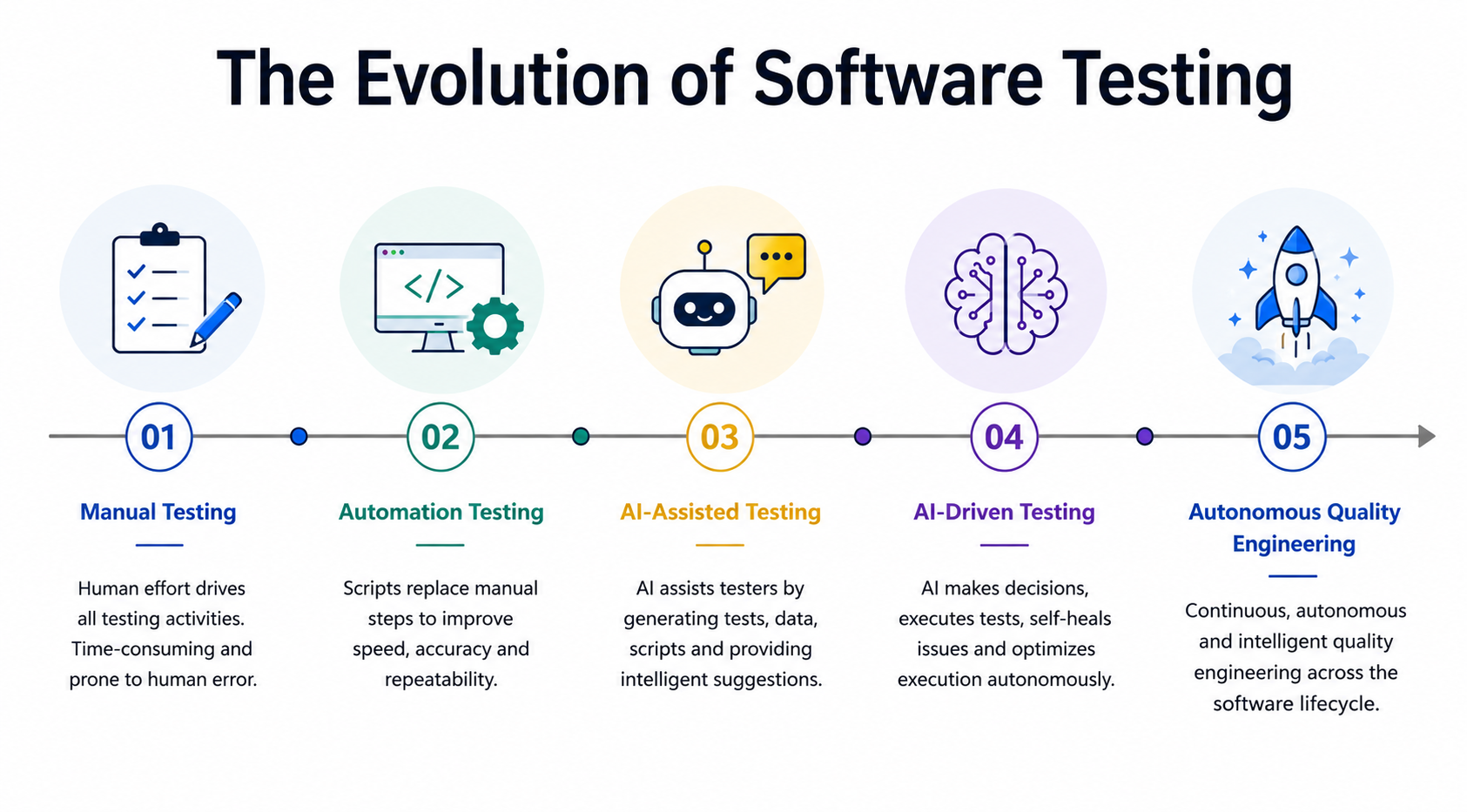
What is AI-Assisted Testing?
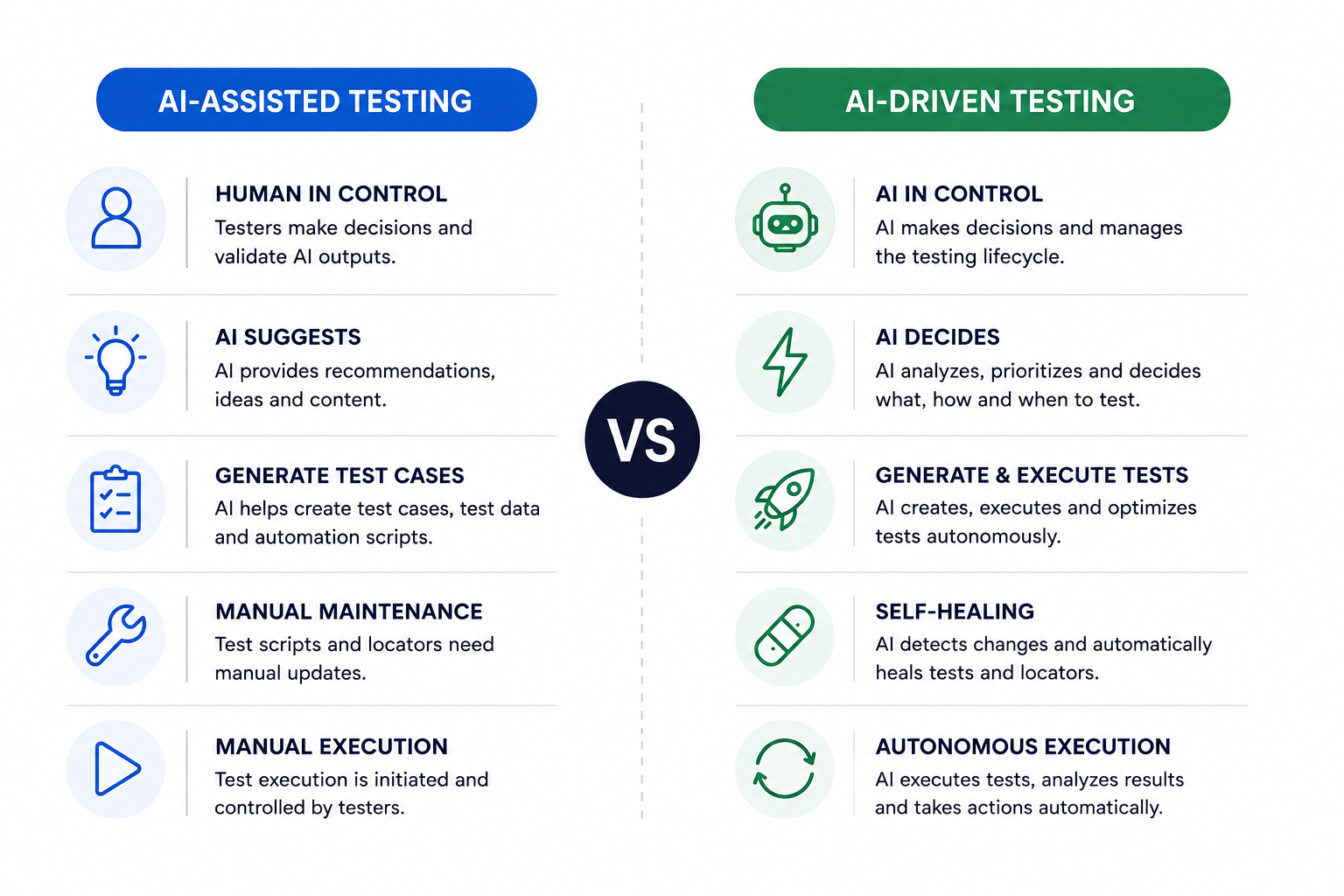
AI-Assisted Testing uses Artificial Intelligence as a productivity accelerator. AI supports testers throughout the testing lifecycle by generating suggestions, automating repetitive tasks, and providing intelligent recommendations. Human testers remain responsible for validating AI-generated outputs and making final decisions.
Think of AI-Assisted Testing as working alongside an experienced testing partner that helps you complete tasks faster without taking control.
Common Use Cases
- Generate manual and automated test cases
- Create automation scripts
- Generate realistic test data
- Recommend regression test scenarios
- Summarize bug reports
- Identify duplicate defects
- Improve test documentation
- Explain failed test results
Example
Imagine a Product Owner creates the following user story:
"As a customer, I want to reset my password using email verification."
Using ChatGPT or GitHub Copilot, a QA engineer can instantly generate:
- Functional test cases
- Negative scenarios
- Boundary value tests
- API validation scenarios
- Suggested Selenium or Playwright automation code
The tester reviews, modifies, and validates the output before execution.
AI improves productivity, while human expertise ensures business accuracy.
What is AI-Driven Testing?
AI-Driven Testing represents the next stage of intelligent automation.
Instead of assisting testers, AI performs many testing activities independently. It continuously learns from previous executions, application changes, user behavior, and historical defects to improve future testing decisions.
Modern AI-Driven platforms can:
- Automatically generate test cases
- Execute regression suites
- Detect UI changes
- Self-heal broken locators
- Prioritize high-risk tests
- Predict production failures
- Optimize test execution
- Learn continuously from historical data
This allows organizations to reduce manual effort while increasing testing speed and reliability.
Example
A web application updates its login page, changing multiple element IDs.
Traditional automation frameworks fail because locators are no longer valid.
An AI-driven testing platform recognizes the visual changes, identifies the new elements, updates the locators automatically, and continues execution without requiring manual script maintenance.
This self-healing capability significantly reduces automation maintenance costs.
AI-Assisted vs. AI-Driven Testing
Benefits of AI-Assisted Testing
Faster Test Design
Generate comprehensive functional, API, regression, accessibility, and edge-case test scenarios within seconds.
Higher Productivity
Reduce repetitive tasks so testers can spend more time on exploratory testing, usability, and business validation.
Better Test Coverage
AI identifies scenarios that may be overlooked during manual planning, improving overall quality.
Less Coding
Automation engineers can generate starter scripts instead of writing them from scratch.
Faster Learning
Junior QA professionals can learn testing techniques, automation practices, and domain knowledge through AI-powered guidance.
Benefits of AI-Driven Testing
Self-Healing Automation
Automatically repairs broken locators after UI updates, reducing maintenance effort.
Intelligent Regression Testing
Runs only the most relevant regression tests based on recent code changes and risk analysis.
Predictive Analytics
Uses historical execution data to identify modules that are most likely to fail.
Faster Releases
Enables rapid feedback and continuous quality throughout the CI/CD pipeline.
Lower Long-Term Cost
Although initial investment is higher, AI-driven automation significantly reduces maintenance costs over time.
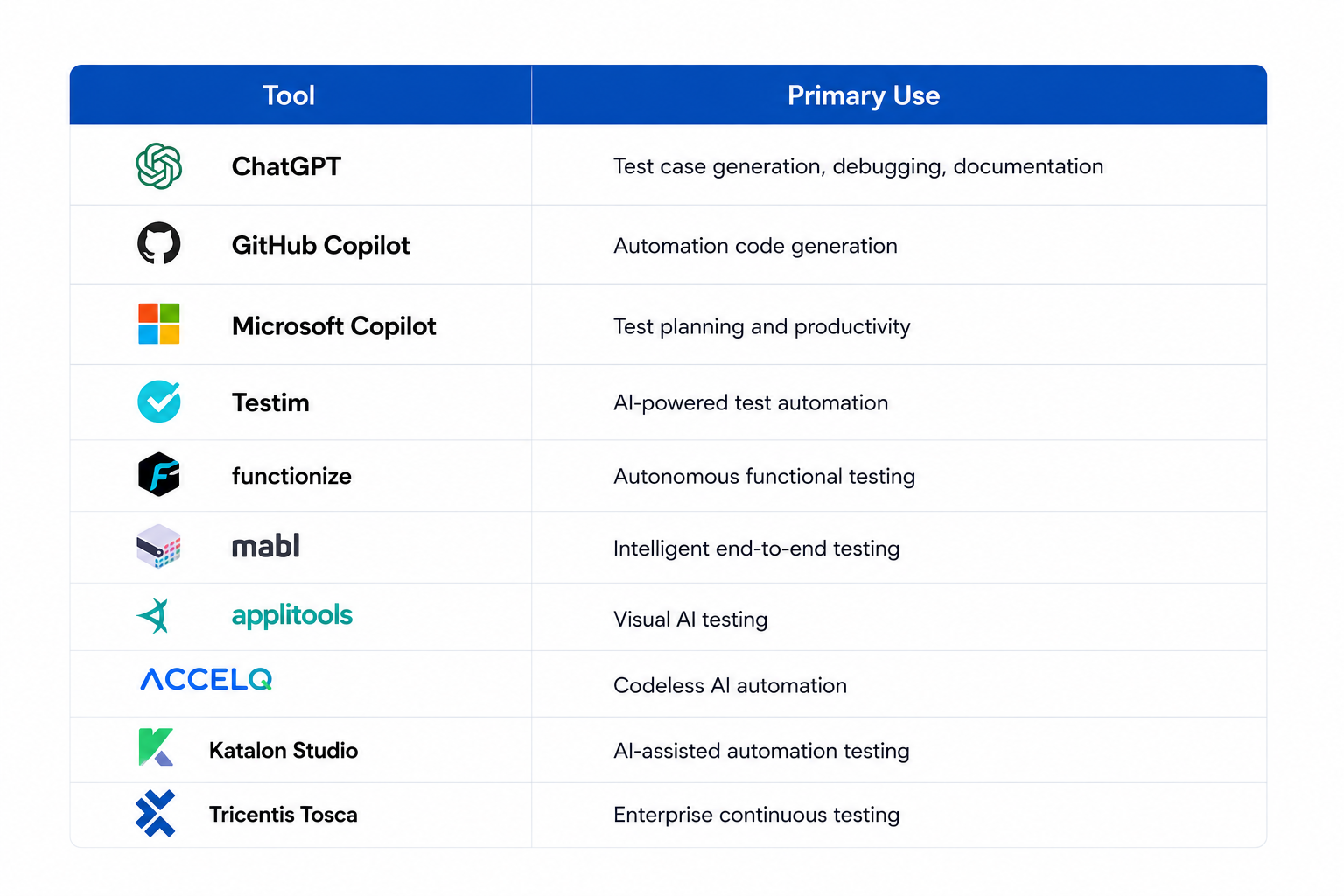
AI Testing Tools Leading the Way in 2026
Real-World Adoption Across Industries
Organizations across industries are already using AI to improve software quality.
Banking and Financial Services
- AI-assisted generation of regulatory test scenarios
- Intelligent fraud detection validation
- Automated regression testing for digital banking platforms
Healthcare
- AI-powered validation of electronic health record systems
- Automated compliance testing
- Risk-based regression execution
Retail and E-commerce
- Autonomous checkout testing
- Visual validation of product pages
- Personalized customer journey testing
SaaS Platforms
- Self-healing UI automation
- Predictive release quality analysis
- Intelligent API testing
Challenges of AI in Software Testing
Despite its advantages, AI adoption comes with challenges.
AI-Assisted Testing
- Requires human validation
- Depends on prompt quality
- Cannot fully understand business context without guidance
AI-Driven Testing
- Higher implementation cost
- Requires quality historical data
- Needs mature automation processes
- Continuous model learning and governance are essential
Organizations should view AI as an enhancement to QA rather than a complete replacement for skilled testers.
Choosing the Right Approach
The right choice depends on your organization's testing maturity.
Choose AI-Assisted Testing if you:
- Are starting your AI adoption journey
- Have mostly manual testing processes
- Want immediate productivity improvements
- Need cost-effective AI adoption
Choose AI-Driven Testing if you:
- Have mature automation frameworks
- Release software frequently
- Maintain large regression suites
- Want autonomous, scalable testing
Many organizations achieve the best results by combining both approaches—using AI-Assisted tools during test design and AI-Driven platforms for execution, maintenance, and optimization.
Software Testing Trends to Watch in 2026
The future of software testing extends beyond simple automation. Key trends include:
- Agentic AI for autonomous testing workflows
- AI-powered exploratory testing assistants
- Predictive quality engineering
- Self-healing automation frameworks
- AI-generated synthetic test data
- Natural language test automation
- Autonomous API testing
- Intelligent visual testing
- AI-powered root cause analysis
- Risk-based testing using machine learning
These innovations are transforming Quality Assurance into Intelligent Quality Engineering.
The Future of AI-Powered Software Testing
Software testing is moving from automation to intelligence.
The role of QA professionals is evolving from executing repetitive tests to designing quality strategies, validating AI outputs, and ensuring exceptional user experiences.
Rather than replacing testers, AI is becoming a trusted collaborator—handling repetitive work while allowing humans to focus on creativity, critical thinking, domain expertise, and customer value.
Organizations that embrace AI while strengthening their testing fundamentals will be better positioned to deliver reliable, secure, and high-quality software in an increasingly competitive market.
Final Thoughts
AI-Assisted Testing and AI-Driven Testing are not competing technologies—they are complementary approaches that solve different challenges.
AI-Assisted Testing empowers QA teams by accelerating test creation, improving productivity, and reducing manual effort while keeping humans in control. AI-Driven Testing builds on that foundation by enabling autonomous test generation, execution, maintenance, and continuous optimization.
As software systems become more intelligent, testing must evolve alongside them.
The future of software quality in 2026 belongs to organizations that combine human expertise with AI-powered testing to build faster, smarter, and more resilient software.
Whether you're beginning your AI journey or scaling enterprise automation, adopting the right AI testing strategy today will define the quality of tomorrow's software.