


Agentic RAG in 2026: Why AI Retrieval Needs a Brain, Not Just a Bigger Vector Database
Discover how Agentic RAG is transforming Enterprise AI in 2026. Learn the key differences between Traditional RAG and Agentic RAG, how AI agents improve retrieval with reasoning and intelligent tool selection, and why businesses are adopting Agentic AI to build more accurate, reliable, and context-aware AI applications.
.png)
2026 is shaping up to be the year of AI Agents. While 2024 popularised Retrieval-Augmented Generation (RAG) and 2025 saw enterprises rapidly adopting AI copilots, 2026 is about building intelligent AI systems that can reason, plan, use tools, and validate their own responses.
Traditional RAG gave Large Language Models (LLMs) access to enterprise knowledge. It solved one of the biggest limitations of standalone language models by allowing them to retrieve information from external knowledge bases instead of relying solely on their training data.
However, access to information is no longer enough.
Modern AI applications need to determine what information is required, where to find it, whether the retrieved data is sufficient, and when to admit they don't have enough information.
That's exactly where Agentic RAG comes in.
Instead of treating retrieval as a fixed step in a pipeline, Agentic RAG transforms retrieval into an intelligent decision-making process powered by AI agents.
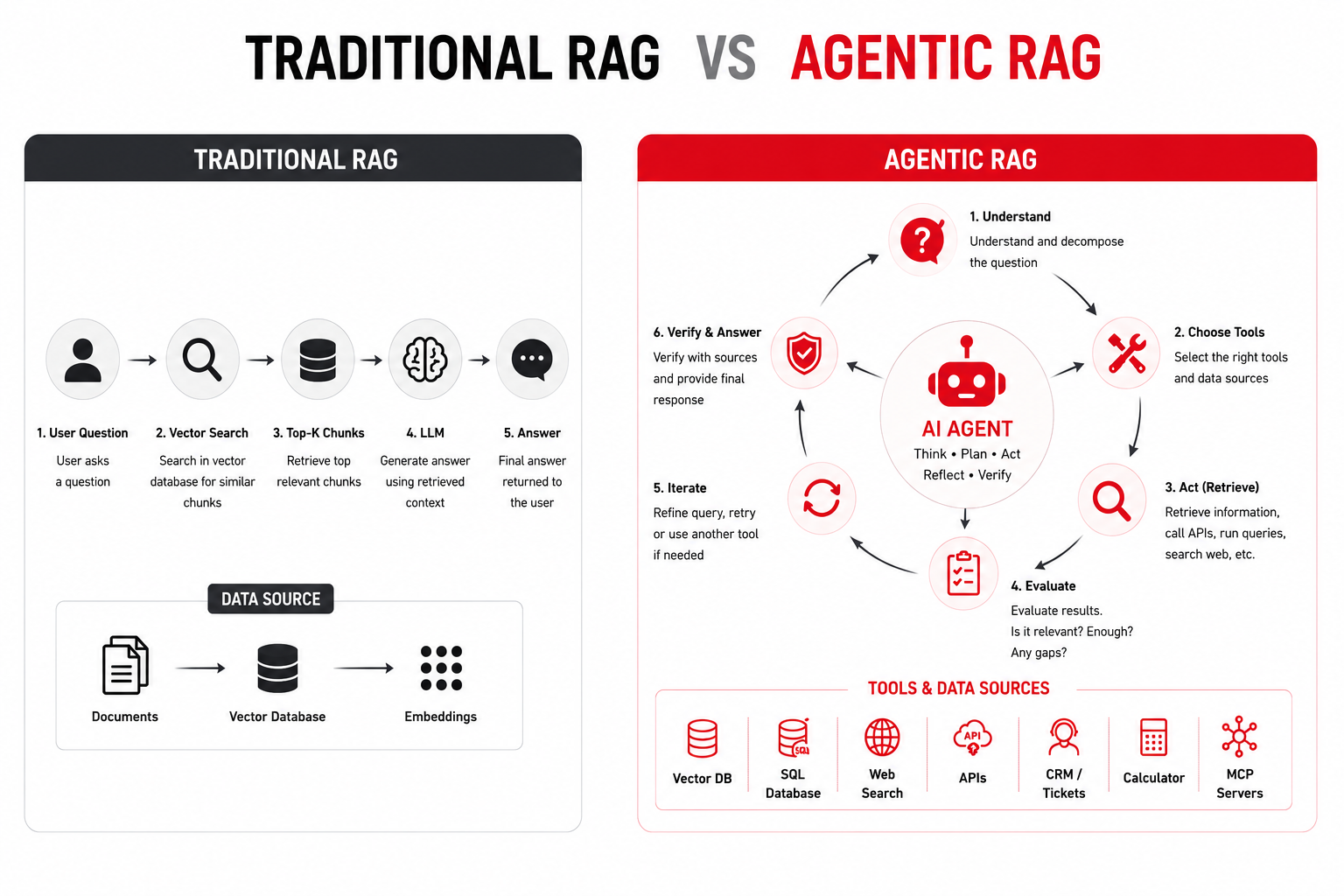
Traditional RAG in One Minute
Most RAG pipelines follow the same architecture.
- Break documents into smaller chunks.
- Convert those chunks into vector embeddings.
- Store them in a vector database.
- Convert the user's question into an embedding.
- Retrieve the most relevant chunks.
- Pass them to the LLM.
- Generate an answer.
This architecture works remarkably well for:
- Internal documentation
- Product manuals
- Company knowledge bases
- HR policies
- FAQs
- Technical documentation
It's also the reason "Chat with your PDF" became one of the most popular AI demos.
For straightforward knowledge retrieval, traditional RAG remains fast, cost-effective, and reliable.
But production AI systems rarely deal with simple questions alone.
Where Traditional RAG Starts to Break
As organisations scale AI across multiple departments and business functions, several limitations become apparent.
One Retrieval Isn't Always Enough
Imagine asking:
"How did customer churn, revenue, and support tickets change after our pricing update?"
This single question actually contains multiple information needs.
- Revenue trends
- Customer churn
- Support ticket volume
- Pricing changes
- Business impact
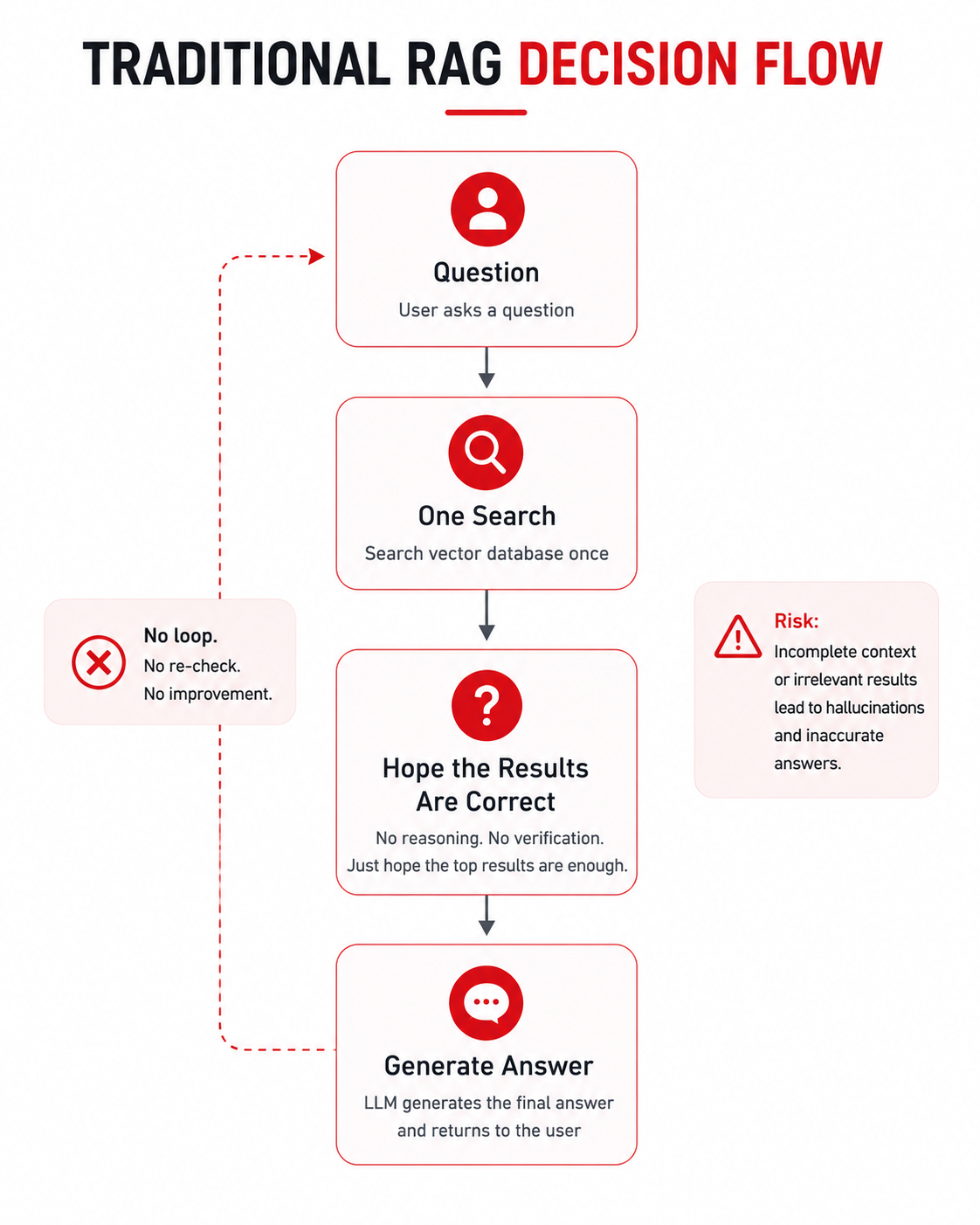
Traditional RAG performs a single similarity search and hopes the retrieved chunks contain everything needed.
More often than not, they don't.
Similar Doesn't Always Mean Relevant
Vector databases retrieve content based on mathematical similarity—not true understanding.
If your knowledge base doesn't contain the answer, traditional RAG still retrieves the "closest" documents.
The LLM then attempts to generate an answer using incomplete or irrelevant context.
This is one of the most common causes of hallucinations in enterprise AI applications.
Every Question Uses the Same Tool
Traditional RAG assumes every question should be answered through vector search.
But different questions require different tools.
QuestionBest SourceCompany policyVector DatabaseLatest AI newsWeb SearchQuarterly revenueSQL DatabaseCustomer ticketCRM or Ticketing APIPercentage calculationCalculator
Treating every problem as a vector search problem limits what AI can do.
No Multi-Step Reasoning
Many business questions require information from multiple systems.
For example:
"Which enterprise customers operate in industries affected by the new EU AI regulations?"
Answering this requires:
- Understanding the regulation.
- Identifying affected industries.
- Searching customer records.
- Matching industries with customers.
Traditional RAG performs only one retrieval.
It simply cannot chain multiple reasoning steps together.
No Verification
Once an answer is generated, traditional RAG stops.
It never asks:
- Did I answer the question completely?
- Are my claims supported by evidence?
- Should I retrieve more information?
Whatever the model generates becomes the final answer.
Enter Agentic RAG
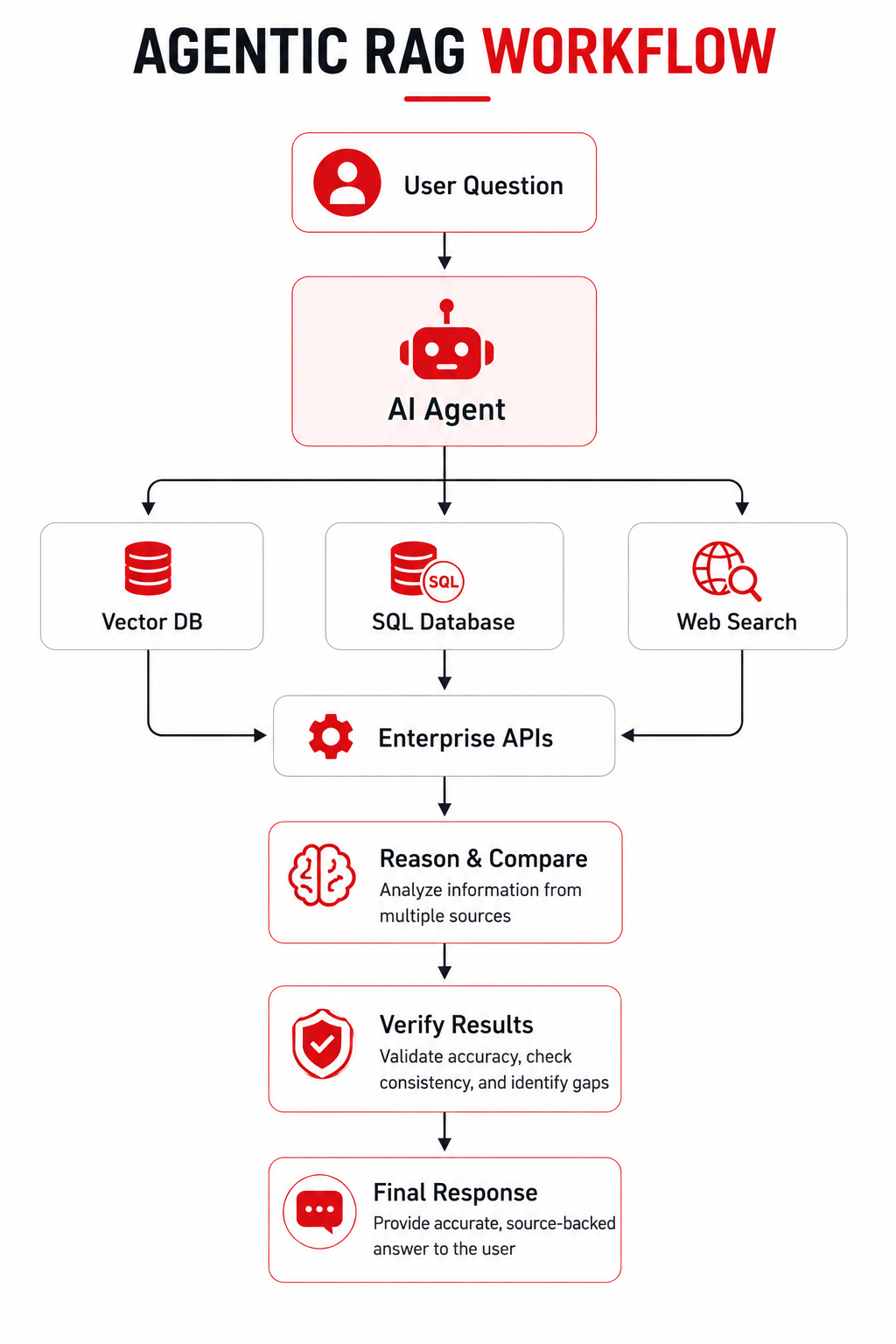
Agentic RAG introduces an AI Agent between the user and the available knowledge sources.
Instead of immediately searching, the AI first thinks.
It asks itself:
- What exactly is the user asking?
- Do I need one search or several?
- Which tools should I use?
- Is the retrieved information sufficient?
- Should I verify my answer?
Retrieval is no longer a single action.
It becomes part of an intelligent reasoning loop.
What Makes Agentic RAG Different?
Query Planning
Instead of embedding the entire question, the AI first understands it.
Complex questions are broken into smaller tasks that can be solved independently before combining the results.
Intelligent Tool Selection
Modern AI applications rarely depend on a single knowledge source.
An AI agent can intelligently choose between:
- Vector databases
- SQL databases
- Enterprise APIs
- CRM systems
- Ticketing platforms
- Web Search
- MCP (Model Context Protocol) servers
- Internal business applications
Rather than forcing every question through vector search, the AI chooses the most appropriate source.
Iterative Retrieval
If the first retrieval doesn't provide enough information, the AI rewrites the query and searches again.
Instead of settling for mediocre context, it actively looks for better evidence.
Self-Reflection
Before responding, the AI evaluates its own work.
It asks:
- Is my answer supported by evidence?
- Did I miss anything?
- Should I retrieve more information?
This greatly reduces hallucinations and improves answer quality.
Memory
Agentic RAG remembers previous interactions.
Follow-up questions no longer start from scratch.
Instead, the AI builds on earlier reasoning and retrieved information, making conversations more natural and context-aware.
A Real-World Example
Imagine a customer asks:
"Compare our refund policy with what we promised customer #4471 and highlight any differences."
Traditional RAG
The entire question becomes one vector search.
The retrieved content may include:
- Parts of the refund policy
- Similar customer conversations
- Unrelated support tickets
The model attempts to combine everything into an answer.
Sometimes it's right.
Sometimes it's not.
Agentic RAG
The AI thinks before acting.
Step 1
Retrieve the latest refund policy.
Step 2
Access ticket #4471 through the customer support API.
Step 3
Compare both documents clause by clause.
Step 4
Verify every identified difference.
Step 5
Generate a side-by-side comparison with supporting evidence.
If the ticket doesn't exist, it reports that fact instead of inventing an answer.
That's the difference between retrieval and reasoning.
Why Enterprises Are Moving to Agentic RAG in 2026
Across industries, AI assistants are expected to work across multiple business systems—not just document repositories.
Typical use cases include:
- Customer Support
- HR Assistants
- IT Service Desk
- Legal Research
- Financial Analysis
- Compliance Monitoring
- Healthcare Knowledge Systems
- Enterprise Search
- AI Software Engineering Assistants
In these scenarios, answers rarely exist in a single document.
They require planning, reasoning, multiple retrievals, and tool orchestration.
That's precisely where Agentic RAG excels.
Is Agentic RAG Always Better?
Not necessarily.
Traditional RAG remains an excellent solution for:
- FAQ bots
- Product documentation
- Employee handbooks
- Small knowledge bases
- Internal search portals
Agentic RAG becomes valuable when questions involve:
- Multiple systems
- Live information
- Business workflows
- Multi-step reasoning
- High-value decision making
For most organisations, the best architecture is a hybrid approach.
Simple questions → Traditional RAG
Complex questions → Agentic RAG
This balances speed, cost, and intelligence.
Getting Started
You don't need to build everything from scratch.
Several frameworks now provide the building blocks for Agentic AI systems, including:
- LangGraph
- LlamaIndex
- Semantic Kernel
- CrewAI
- OpenAI Agents SDK
- Google Agent Development Kit (ADK)
A practical roadmap looks like this:
- Build a traditional RAG pipeline.
- Measure retrieval quality.
- Add query rewriting.
- Introduce retrieval grading.
- Add intelligent tool routing.
- Implement multi-step reasoning where needed.
Start simple, measure performance, and introduce intelligence only where it delivers measurable value.
Final Thoughts
Retrieval-Augmented Generation transformed AI by making enterprise knowledge searchable.
But in 2026, retrieval alone is no longer enough.
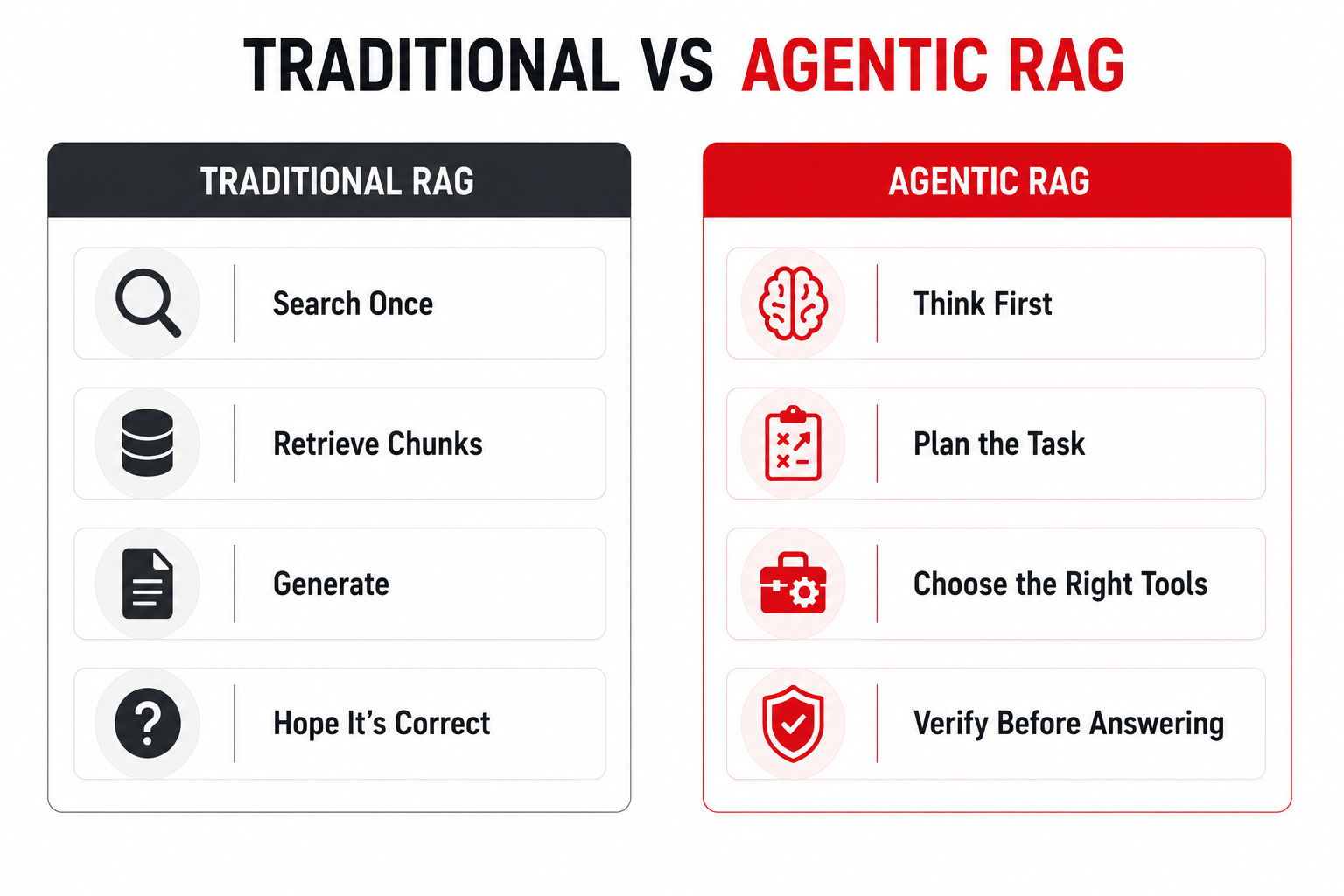
Modern AI systems must understand the question, choose the right tools, retrieve information from multiple sources, validate their findings, and explain their reasoning before responding.
That's exactly what Agentic RAG enables.
As AI agents become the standard interface for enterprise applications, the difference won't be measured by how much information an AI can retrieve—but by how intelligently it can retrieve, evaluate, and act on that information.
Traditional RAG helped AI find information.
Agentic RAG helps AI think before it answers.
For organisations building the next generation of Enterprise AI solutions, that difference could define the success of every AI-powered experience.
Key Takeaways
Traditional RAG works well for simple document search.
Agentic RAG adds planning, reasoning, and intelligent tool selection.
AI Agents can combine vector search, SQL, APIs, web search, and enterprise systems into a single workflow.
Self-verification and iterative retrieval significantly reduce hallucinations.
In 2026, the future of Enterprise AI isn't just better retrieval—it's intelligent retrieval powered by AI agents.