


The Future of Work: Skills Professionals Need in an AI-Driven World
AI is transforming jobs across industries. Learn the key skills professionals need to stay relevant, productive, and competitive in the future workplace.

Not long ago, conversations about Artificial Intelligence were focused on what might happen in the future.
Today, AI is already part of everyday work. From drafting emails and summarizing documents to analyzing data and automating repetitive tasks, AI is helping people work faster and more efficiently across industries.
This has led to an important question:
What skills will matter most in an AI-driven world?
While AI is changing the way work gets done, it isn't replacing the need for human capabilities. In fact, many of the skills that make people valuable at work are becoming even more important.
According to the World Economic Forum's Future of Jobs Report, employers expect a significant transformation in workplace skills by 2030. The challenge for professionals isn't simply learning new tools—it's developing the skills that help them adapt and thrive alongside technology.

AI Literacy
Just as computer skills became essential in the digital age, AI literacy is quickly becoming a workplace necessity. This doesn't mean everyone needs to become an AI expert. However, understanding how AI works, where it can help, and where human oversight is needed will become increasingly important.
Microsoft's 2025 Work Trend Index found that 82% of business leaders believe AI is reshaping how organizations operate and create value.
Today, many professionals use AI to summarize information, generate ideas, automate routine tasks, and improve productivity. The goal isn't to become an AI expert overnight. It's to understand where AI can help, where human judgment is still needed, and how the two can work together effectively.
Critical Thinking
AI can provide answers quickly, but it cannot fully understand context, priorities, or long-term goals. That's why critical thinking remains one of the most valuable workplace skills.
The World Economic Forum identifies analytical thinking as one of the most sought-after skills among employers. Whether reviewing a recommendation, evaluating information, or making decisions, professionals need the ability to assess situations thoughtfully rather than accepting every AI-generated output at face value.
As AI-generated content becomes more common, professionals who can question assumptions, validate information, and make sound decisions will become increasingly valuable.
Creativity and Innovation
One of the biggest misconceptions about AI is that it will replace creativity. In reality, AI is helping people explore ideas faster, but innovation still depends on human thinking.
AI can generate options, suggest approaches, and accelerate brainstorming. However, identifying meaningful opportunities, understanding human needs, and creating original solutions remain distinctly human strengths.
As AI makes it easier to generate ideas, the ability to identify meaningful opportunities and turn them into innovative solutions becomes even more important.
Communication Skills
Technology can help create presentations, reports, and messages. What it cannot do is build understanding between people. Strong communication skills help professionals explain ideas clearly, align teams, manage stakeholders, and influence decisions. Research consistently ranks communication among the most in-demand workplace skills across industries.
As workplaces become increasingly supported by technology, the ability to communicate clearly, build relationships, and inspire action remains a powerful advantage.
Emotional Intelligence
Work is ultimately about people. Empathy, collaboration, leadership, and relationship-building remain difficult to automate.
The World Economic Forum highlights leadership, social influence, and resilience among the fastest-growing workplace skills. Whether managing a team, supporting customers, or working with colleagues, emotional intelligence helps build trust and strengthen relationships.
While technology can improve efficiency, trust, empathy, and collaboration continue to be qualities that people value most in professional relationships.
Adaptability and Continuous Learning
The workplace is evolving faster than ever. New technologies, tools, and ways of working continue to emerge, requiring professionals to learn and adapt throughout their careers.
LinkedIn research suggests that the skills required for many jobs could change significantly by 2030 due to advancements in technology. The professionals most likely to succeed are not necessarily those with the most knowledge today, but those willing to keep learning tomorrow.
In a world where technology is constantly evolving, the ability to learn and adapt may be the most important skill of all.
Data Literacy
Data plays a role in nearly every business decision. While AI can process information and identify patterns, people still need to understand what the data means and what actions should be taken.
Professionals who can interpret trends, understand metrics, and make informed decisions will continue to be in demand. According to PwC, AI is driving productivity improvements across industries, making data-driven decision-making increasingly important.
AI can help uncover patterns and opportunities, but meaningful decisions still depend on human understanding and judgment.
The Real Opportunity
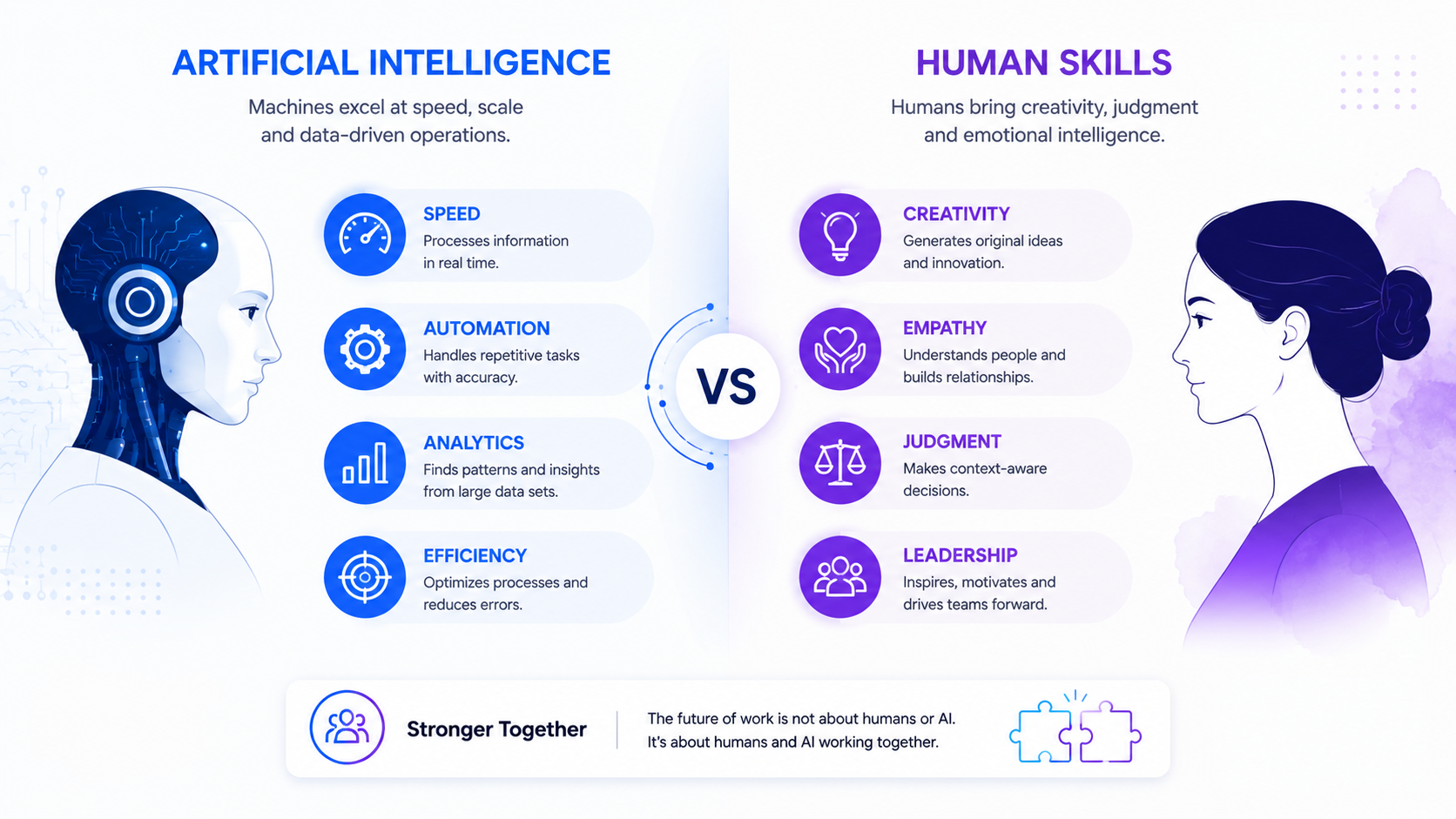
The future of work isn't about humans versus AI. It's about combining the strengths of both. AI brings speed, efficiency, automation, and scale. Humans bring creativity, judgment, empathy, leadership, and strategic thinking.
The most successful professionals will be those who learn how to use technology while continuing to strengthen the skills that make them uniquely human.
Final Thoughts
AI will continue to evolve. New tools will emerge. Job roles will change. But qualities such as curiosity, creativity, communication, empathy, and critical thinking will remain valuable regardless of how advanced technology becomes.
The future doesn't belong to those who know everything. It belongs to those who stay curious, keep learning, and adapt to change.
The most successful professionals won't be the ones competing with AI. They'll be the ones who learn how to use it to amplify their strengths and focus on the work that only humans can do.
AI can make us faster. Human skills make us valuable.
Sources:
- World Economic Forum – Future of Jobs Report 2025
- Microsoft – Work Trend Index 2025
- LinkedIn Economic Graph Research
- PwC AI Jobs Barometer