


Small Language Models (SLMs) vs. Large Language Models (LLMs): Differences, Use Cases & How to Choose the Right AI Model
Confused about the difference between Small Language Models (SLMs) and Large Language Models (LLMs)? This guide explains how each works, their strengths, real-world use cases, and how to choose the right AI model for your business or project.
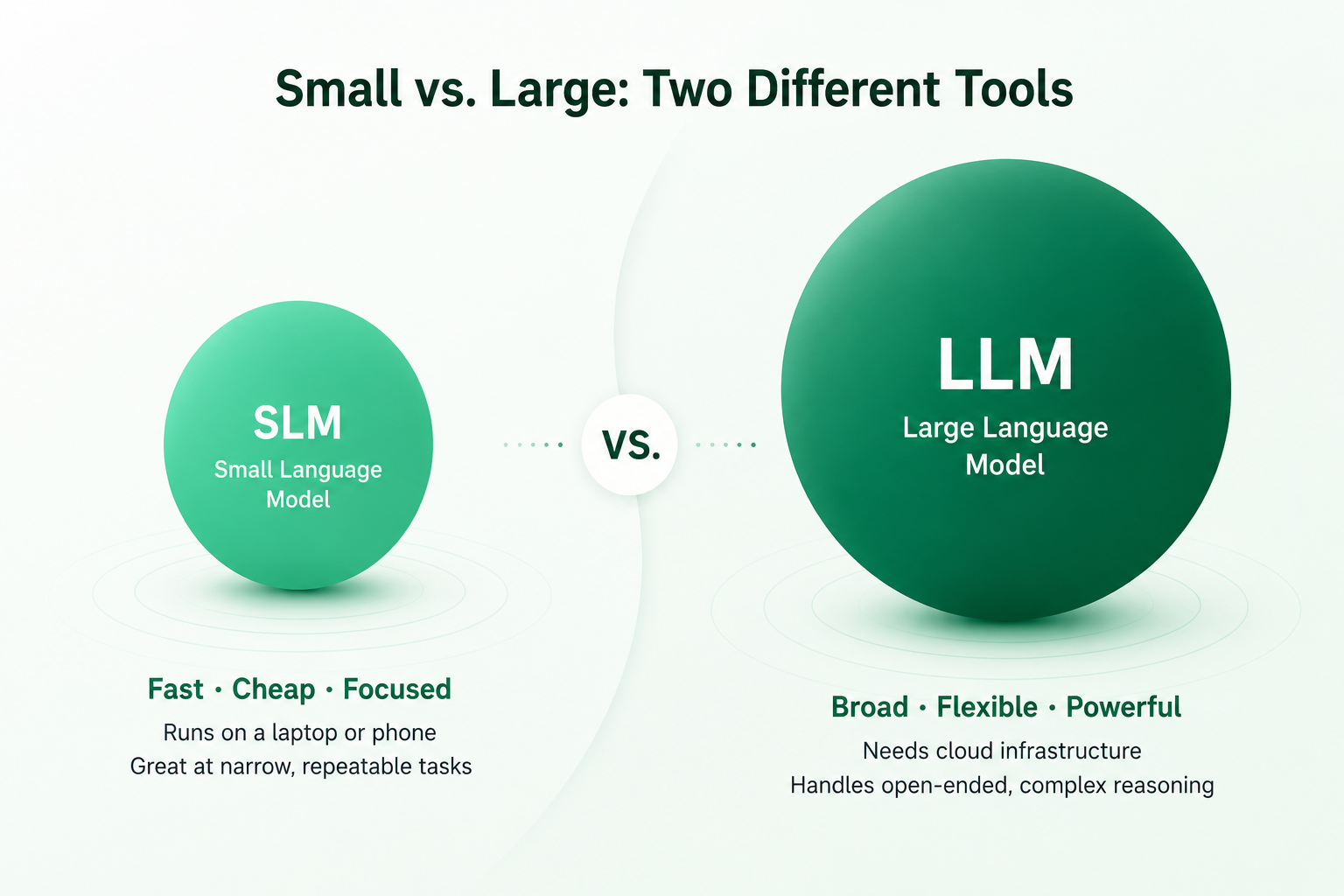
If you've recently started exploring AI, you've probably come across two terms: Small Language Models (SLMs) and Large Language Models (LLMs).
At first, they sound technical. But the difference between them is actually quite simple.
The real question isn't "Which one is better?" It's "Which one is the right fit for my project?"
In this guide, we'll explain the differences in plain English, compare their strengths, explore real-world use cases, and help you decide which type of AI model makes the most sense for your business.
Quick Answer
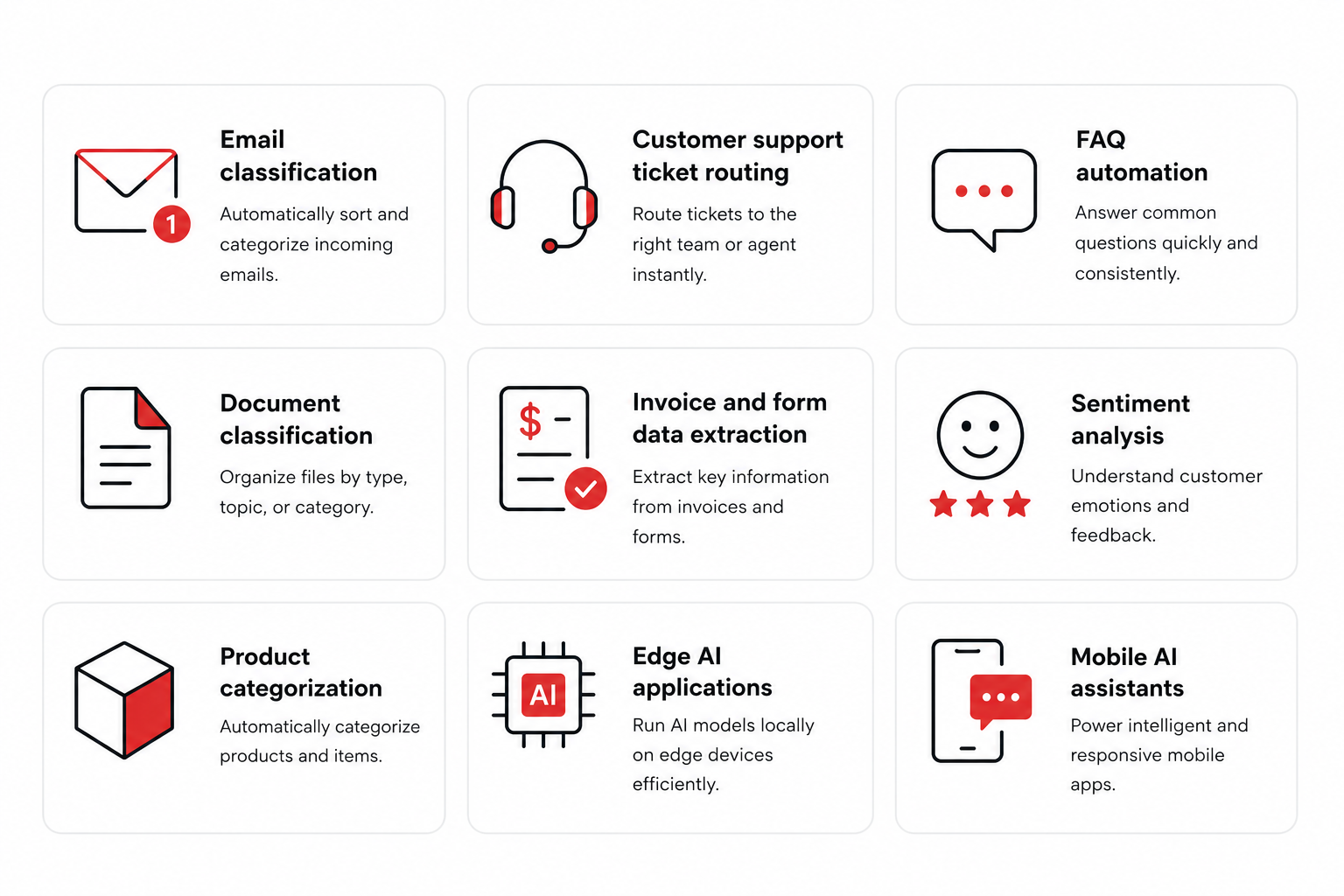
Small Language Models (SLMs) are best for repetitive, well-defined tasks that require speed, low cost, and privacy. Examples include email classification, ticket routing, document extraction, and FAQ automation.
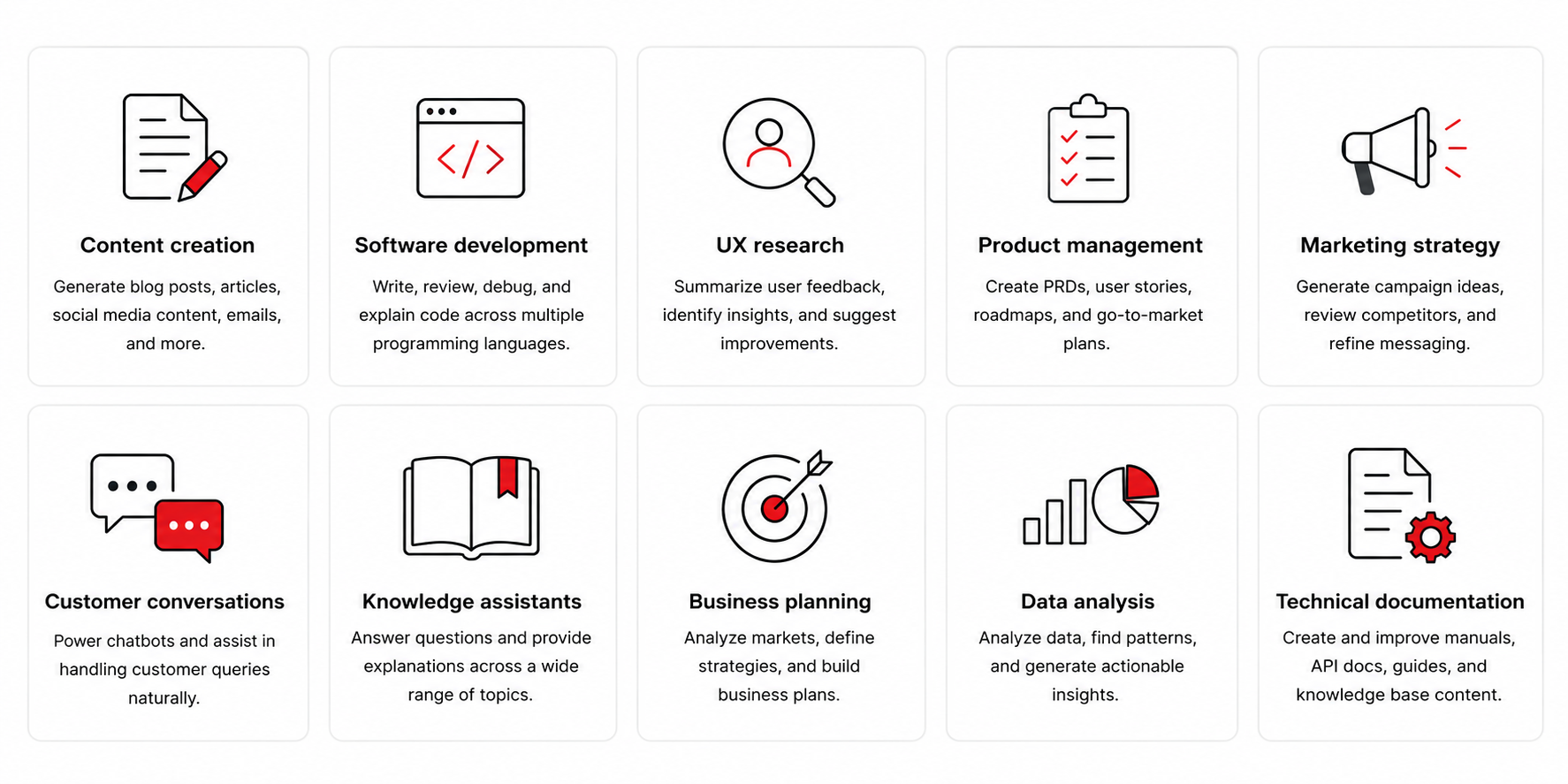
Large Language Models (LLMs) are designed for complex reasoning, content generation, coding, research, planning, and open-ended conversations. They offer greater flexibility but require more computing power and are generally more expensive.
Many organizations don't choose one or the other—they combine both. Small models handle routine requests, while larger models step in for tasks that require deeper reasoning or creativity.
What Is a Language Model?
A language model is an AI system trained on enormous amounts of text so it can understand and generate human language.
Instead of writing hundreds of rules or complex code, you simply describe what you need in plain English.
For example, you could ask an AI model to:
- Answer customer questions
- Summarize documents
- Write emails or blog posts
- Generate code
- Analyze customer feedback
- Translate languages
- Brainstorm business ideas
Think of it as working with an incredibly well-read assistant. You ask a question, and it responds based on everything it has learned during training.
The difference between a Small Language Model and a Large Language Model comes down to how much knowledge it has, how well it can reason, and what types of tasks it's designed to handle.
What Is a Small Language Model (SLM)?
Imagine hiring someone whose only responsibility is sorting customer emails.
Their job is straightforward.
- Is this about billing?
- Is it a shipping question?
- Is it a product complaint?
- Should it go to technical support?
They don't need to know world history or write marketing campaigns. They simply need to perform one task quickly and accurately.
That's exactly what a Small Language Model is designed to do.
Rather than trying to solve every possible problem, SLMs focus on a smaller set of well-defined tasks. Because of that, they're typically faster, cheaper to run, and easier to deploy.
Why Businesses Choose Small Language Models
Lower operating costs
If your application processes thousands—or even millions—of requests every day, every fraction of a cent matters.
Small models require less computing power, making them a cost-effective choice for high-volume workloads.
Faster responses
Since they contain fewer parameters, SLMs often respond in milliseconds, making them ideal for customer-facing applications that demand speed.
Better privacy
Many Small Language Models can run directly on laptops, mobile devices, or private servers.
That means sensitive business or customer data doesn't need to leave your environment, making them attractive for industries with strict privacy and compliance requirements.
Consistent output
Because they're trained for specific tasks, SLMs tend to produce predictable and reliable results. They're less likely to generate unexpected responses.
Common Use Cases for Small Language Models
Small Language Models are commonly used for:
What Is a Large Language Model (LLM)?
Now imagine someone who's read millions of books, research papers, websites, manuals, and articles.
You ask them to:
- Write a marketing campaign
- Review software code
- Create a presentation
- Explain cybersecurity concepts
- Brainstorm startup ideas
- Summarize research papers
They're comfortable moving between completely different topics because they've learned from a vast range of information.
That's how a Large Language Model works.
Instead of specializing in one task, LLMs are designed to adapt to many different problems without requiring additional training.
Why Businesses Choose Large Language Models
Flexibility
Large Language Models can switch effortlessly between writing, coding, research, planning, customer support, and many other tasks.
Better reasoning
When a problem requires multiple steps or careful analysis, LLMs generally perform much better than smaller models.
Broad knowledge
Large models have learned from an enormous range of information, allowing them to assist across different industries and domains.
Creativity
Whether you're brainstorming campaign ideas, writing documentation, creating presentations, or generating content, LLMs are valuable creative partners.
The trade-off is that this flexibility comes with higher infrastructure costs and slightly longer response times.
Common Use Cases for Large Language Models
LLMs are widely used for:
Small Language Models vs. Large Language Models
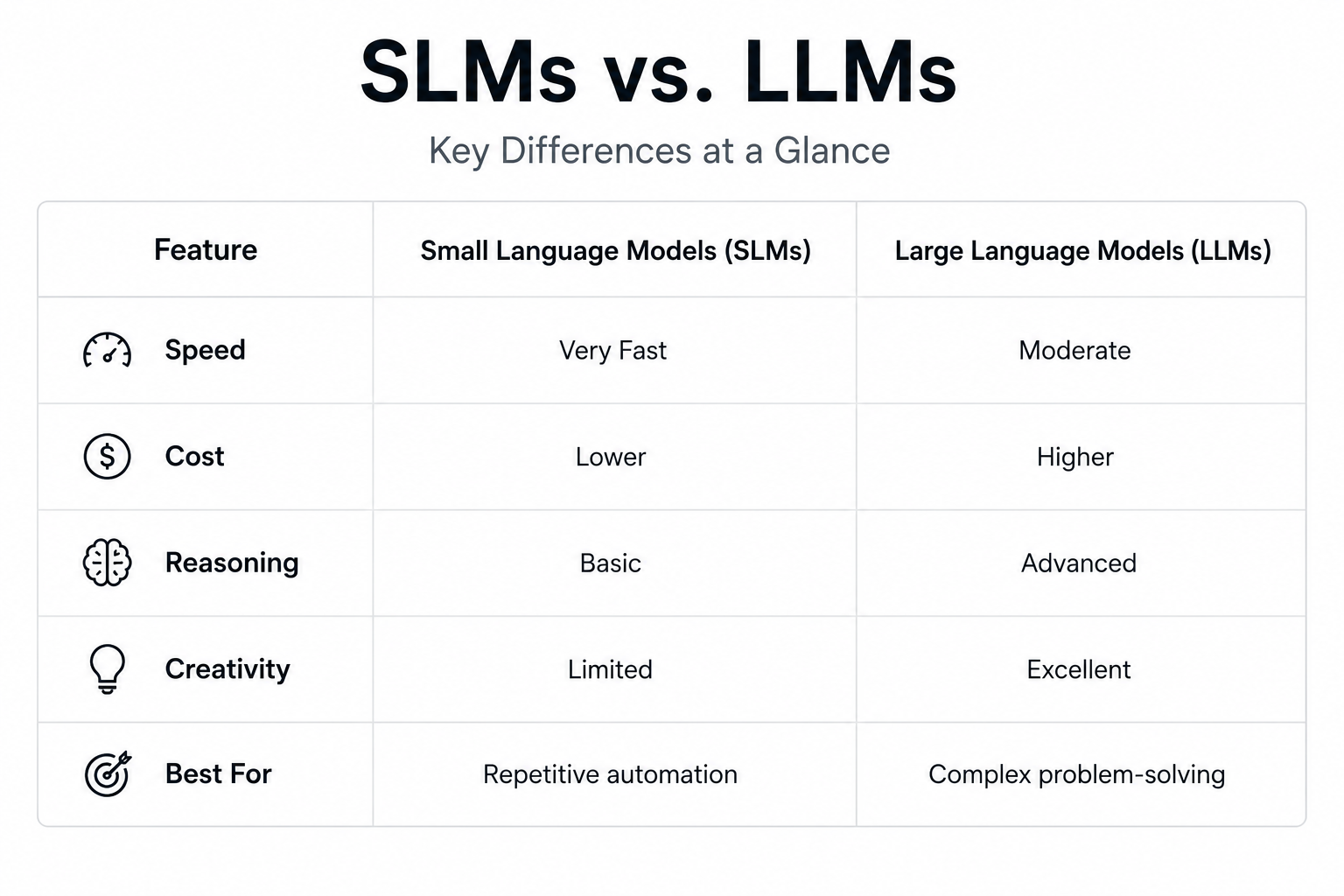
When Should You Use a Small Language Model?
A Small Language Model is often the better choice when:
- The task is repetitive.
- Every request follows a similar pattern.
- Low operating costs are important.
- Fast responses matter.
- You need the model to run locally or offline.
- Privacy and compliance are top priorities.
Example
A logistics company receives thousands of shipment tracking requests every day.
Most customers simply want to know:
"Where is my package?"
A Small Language Model can answer these requests instantly without needing the power of a larger AI system.
When Should You Use a Large Language Model?
A Large Language Model is the better choice when:
- Every request is different.
- The AI needs to reason through complex problems.
- Creativity is important.
- Users ask open-ended questions.
- Multiple pieces of information need to be combined.
Example
A marketing manager wants help creating an entire product launch campaign.
The AI needs to:
- Research competitors
- Suggest campaign ideas
- Write emails
- Create social media content
- Build a launch timeline
That's exactly the kind of work where a Large Language Model excels.
Can You Use Both Together?
Absolutely.
In fact, many successful AI applications combine both types of models.
Imagine an online retailer receiving thousands of customer messages every day.
Most questions are straightforward.
- "Where's my order?"
- "How do I return an item?"
- "When will my package arrive?"
A Small Language Model can answer these almost instantly.
But then a customer asks:
"My order arrived damaged after multiple delivery delays, and I'd like to know my options."
Now the AI needs to understand context, interpret company policies, and provide a thoughtful response.
Instead of forcing the Small Language Model to handle everything, the request is automatically passed to a Large Language Model—or, in some cases, a human support agent.
This hybrid approach delivers faster responses for routine questions while keeping costs under control and ensuring complex situations receive the attention they deserve.
Getting Started: A Simple 3-Step Approach
If you're new to AI, don't spend weeks trying to choose the perfect model. Start with your problem, test with real examples, and let the results guide your decision.
1. Clearly define the problem you're trying to solve
Before thinking about models, write down exactly what you want the AI to do.
Instead of saying:
"Build an AI chatbot."
Be more specific:
"Answer customer questions about order status and return policies."
The clearer the problem, the easier it becomes to choose the right solution.
2. Start by testing with a Large Language Model
Even if you think a Small Language Model might be enough, begin with a Large Language Model.
This helps you understand what's possible and gives you a benchmark for what a high-quality response looks like.
Test it with real examples, refine your prompts, and identify where AI delivers the most value.
3. See if a Small Language Model can do the same job
Once you've identified a repetitive, well-defined task, try replacing the Large Language Model with a Small Language Model.
If the quality remains consistent, you'll benefit from faster responses, lower operating costs, and in many cases, the ability to run the model locally for improved privacy.
There's no universal "best" model. The right choice depends on your use case. Start simple, experiment with real scenarios, and let the results shape your AI strategy.
Frequently Asked Questions
Is a Small Language Model better than a Large Language Model?
Not necessarily. Small Language Models are better for repetitive, high-volume tasks where speed and cost matter. Large Language Models are better for reasoning, creativity, and solving complex problems. The right choice depends on your specific use case.
Can Small Language Models run offline?
Yes. Many Small Language Models are lightweight enough to run on laptops, smartphones, edge devices, or private servers. This makes them a strong choice for applications that require better privacy or limited internet connectivity.
Why do companies use both SLMs and LLMs?
Many organizations use a hybrid approach. Small Language Models handle routine, repetitive requests, while Large Language Models take over when tasks require deeper reasoning, creativity, or more context. This improves efficiency while keeping operating costs under control.
Which AI model should beginners start with?
A Large Language Model is often the best place to begin because it helps you quickly validate your idea and understand what's possible. Once you've identified repetitive tasks, you can evaluate whether a Small Language Model can deliver similar results more efficiently.
Final Thoughts
Choosing between a Small Language Model and a Large Language Model isn't about finding the biggest or smartest AI. It's about selecting the model that best matches your business goals, technical requirements, budget, and user experience.
If your workload is repetitive, predictable, and high-volume, a Small Language Model can help reduce costs, improve speed, and keep sensitive data closer to home.
If your work requires creativity, reasoning, or the flexibility to solve new challenges every day, a Large Language Model is the better fit.
And for many real-world applications, the most effective approach is a combination of both. Start with a clear understanding of the problem you're solving, experiment with real use cases, and let data—not assumptions—guide your decisions.
The best AI model isn't always the largest one. It's the one that helps you solve the right problem in the most effective way.