


Leveraging AI Tools as a Business Analyst
In today’s fast-evolving digital landscape, the role of a Business Analyst (BA) is expanding beyond traditional requirement gathering and documentation. With the rise of Artificial Intelligence (AI), Business Analysts now have access to powerful tools that enhance productivity, improve decision-making, and deliver greater business value. When used effectively, AI acts as an intelligent assistant supporting, not replacing, the BA’s expertise.
In today’s fast-evolving digital landscape, the role of a Business Analyst (BA) is expanding beyond traditional requirement gathering and documentation. With the rise of Artificial Intelligence (AI), Business Analysts now have access to powerful tools that enhance productivity, improve decision-making, and deliver greater business value. When used effectively, AI acts as an intelligent assistant supporting, not replacing, the BA’s expertise.
How AI Supports Business Analysts
AI tools assist Business Analysts across the entire project lifecycle, from understanding business problems to validating solutions and supporting strategic decisions.
Requirement Gathering and Analysis
Business Analysts often work with large volumes of unstructured data such as emails, surveys, stakeholder interviews, support tickets, and user feedback.
Real-world tools and examples:
- ChatGPT / Microsoft Copilot: To summarize stakeholder interviews and extract key requirements.
- Text analytics tools: To identify recurring issues in customer feedback or incident logs.
- Power BI: To analyze historical data and uncover trends impacting requirements.
Value delivered:
AI helps identify patterns quickly, allowing BAs to focus discussions on high-impact business needs instead of manual data review.
Documentation and User Story Creation
Clear and consistent documentation is a core BA responsibility, but it can be time-consuming.
Real-world tools and examples:
- ChatGPT / Copilot: To draft BRDs, FRDs, user stories, and acceptance criteria.
- Confluence AI: To refine language, improve clarity, and summarize lengthy requirement pages.
- Jira AI features: To convert high-level requirements into structured user stories.
Example scenario:
A BA inputs a business objective, uses AI to generate an initial set of user stories, and then refines them using domain knowledge and stakeholder feedback.
Process Modeling and Improvement
Understanding and optimizing business processes is central to delivering value.
Real-world tools and examples:
- Process mining tools (e.g., Celonis): To identify bottlenecks using actual execution data.
- Lucidchart or Miro (AI-assisted diagrams): To quickly create and refine process flows.
- AI-driven automation suggestions: To highlight repetitive manual steps suitable for automation.
Value delivered:
AI enables data-backed process improvements rather than assumption-based recommendations.
Stakeholder Communication and Collaboration
Strong communication ensures alignment across teams.
Real-world tools and examples:
- Microsoft Teams Copilot or Otter.ai: To capture meeting notes, decisions, and action items.
- ChatGPT: To summarize discussions into stakeholder-friendly updates.
- Email AI assistants: To draft clear and professional communication.
Benefit:
Less time spent on manual documentation and more time on active listening and stakeholder engagement.
Decision Support and Business Insights
AI strengthens the BA’s role as a strategic advisor.
Real-world tools and examples:
- Power BI and Excel AI features: predictive analysis and trend forecasting.
- What if scenario analysis tools: To evaluate solution options.
- AI-assisted comparison models: To assess cost, risk, and business impact.
Value delivered:
Business decisions are supported with data-driven, forward-looking insights.
AI Tools Stack for Business Analysts
To effectively leverage AI, Business Analysts can adopt a practical tools stack aligned with their responsibilities:
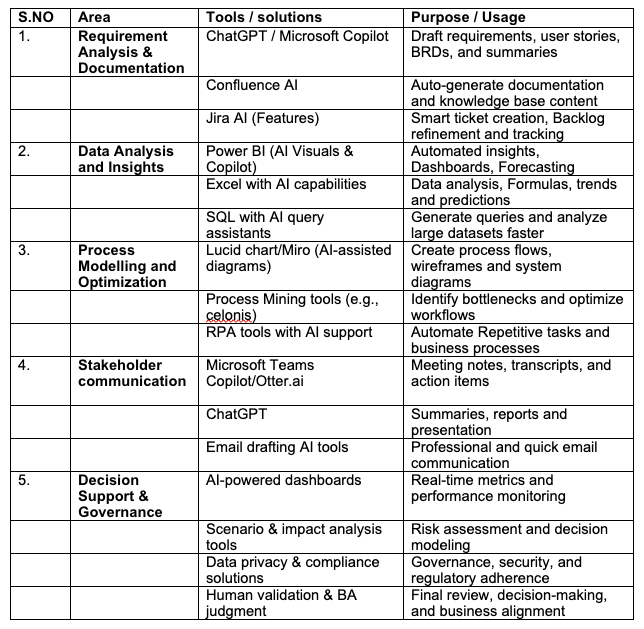
A well-chosen AI tools stack enables Business Analysts to improve efficiency while maintaining accountability, accuracy, and business alignment.
Responsible and Ethical Use of AI
While AI enhances productivity, Business Analysts must use it responsibly by:
- Validating AI-generated outputs
- Protecting sensitive business data
- Being transparent about AI usage
- Applying critical thinking and domain expertise
AI should support decisions that do not replace professional judgment.
Conclusion
Leveraging AI tools allows Business Analysts to work more efficiently, communicate more effectively, and deliver stronger business outcomes. By combining AI capabilities with human insight, ethical responsibility, and stakeholder collaboration, Business Analysts can evolve into more strategic and value-driven professionals. Embracing AI is not about changing the BA role; it’s about enhancing it.