


Best AI Assistants for Developers in 2025: A Comprehensive Comparison
Artificial Intelligence has rapidly evolved from being just a productivity enhancer to a core part of every developer’s workflow. From coding assistants to autonomous browsers, choosing the right AI tool can directly impact speed, security, and innovation.
Artificial Intelligence has rapidly evolved from being just a productivity enhancer to a core part of every developer’s workflow. From coding assistants to autonomous browsers, choosing the right AI tool can directly impact speed, security, and innovation.
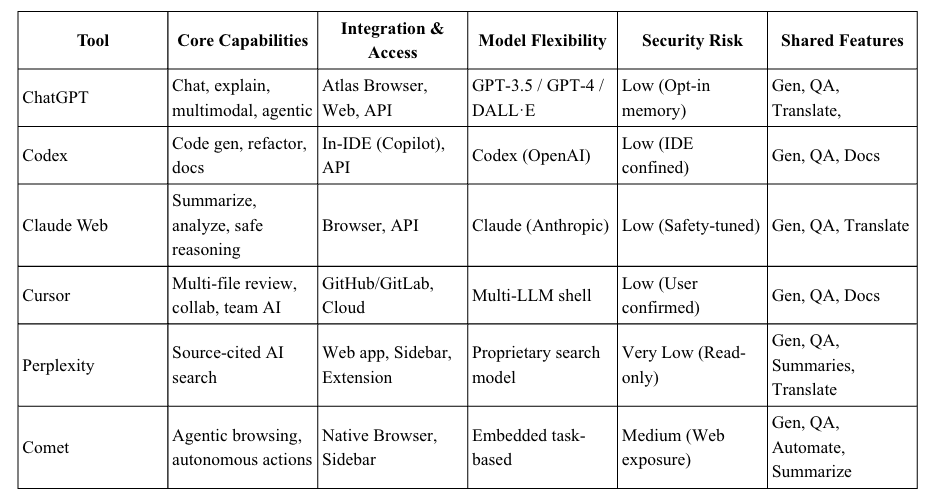
This guide compares the six leading AI assistants in 2025 — ChatGPT, Codex, Claude Web, Cursor, Perplexity, and Comet — across five crucial dimensions:
- Capabilities
- Integration & Access
- Model Selection & Flexibility
- Security
- Shared Core Features
AI Assistant Capabilities: What Each Tool Excels At
Each assistant shines in different areas — from writing code to performing deep research or autonomous actions.
- ChatGPT (Atlas): A powerhouse for natural language understanding, multilingual translation, document analysis, and agentic automation via the Atlas browser. Perfect for general productivity and technical Q&A.
- Codex: The developer’s companion for coding. Offers smart completions, code refactoring, instant documentation, and API-based automation.
- Claude Web: Known for context depth and safe reasoning, it excels in long-form analysis, policy insights, and research synthesis.
- Cursor: Designed for engineering teams, enabling real-time code reviews, workflow automation, and team collaboration directly from repositories.
- Perplexity: Acts as a conversational AI search engine that returns cited, concise answers from the live web. Great for knowledge retrieval and validation.
- Comet: Pushes boundaries with autonomous browsing, multi-tab context, and independent execution — analyzing or booking tasks without user intervention.
Integration & Access: Where and How Developers Use Them
AI tools are only as useful as their integration flexibility. Here’s how each fits into a modern tech stack:
- ChatGPT: Seamlessly embedded in Atlas Browser (macOS), with API and web access. Agentic automation available on premium plans.
- Codex: Deep IDE integration with VS Code and PyCharm via GitHub Copilot, plus API for embedding into workflows.
- Claude Web: Available through web browsers or APIs; ideal for researchers and writers across devices.
- Cursor: Integrates with GitHub, GitLab, and cloud repositories — making it a favorite for collaborative coding teams.
- Perplexity: Works via web, sidebar, and browser extensions — no login required for fast Q&A and cited summaries.
- Comet: Native browser integration with Perplexity Search, agentic sidebar, and autonomous web actions — now open beyond premium users.
Model Selection & Flexibility: Customizing the AI Core
Model diversity defines adaptability. Here’s what powers each assistant:
- ChatGPT: Uses GPT-3.5, GPT-4, and DALL·E, offering multimodal input (text, image, file). Model selection gives control over context and creativity.
- Codex: Based on OpenAI’s Codex model, optimized for programming languages and API automation.
- Claude Web: Runs on Anthropic’s Claude family, offering one of the largest context windows and safety-aligned reasoning.
- Cursor: Serves as a multi-LLM shell, connecting with various large language models for code, documentation, and collaboration.
- Perplexity: Powered by Perplexity’s proprietary AI, optimized for real-time web search with source citations.
- Comet: Embeds the Perplexity model but focuses on agentic task automation rather than model switching.
Security: Balancing Autonomy and Privacy
As AI becomes more autonomous, security and data privacy become mission-critical.
- Comet: Faces higher exposure due to agentic browsing — malicious web content can embed commands. Some mitigations exist, but caution is advised.
- Strawberry Browser (experimental): Similar security risks due to autonomous web control.
- ChatGPT, Claude Web, Cursor, Codex: Low risk — explicit user confirmation required before any action; strong privacy controls and opt-in data retention.
- Perplexity: Minimal write permissions; does not store personal data. Operates as a read-only, citation-based AI.
Shared Core Features Across All AI Assistants
Despite their differences, most AI assistants share a common foundation of intelligent capabilities:
- Natural Language Generation: Write, explain, and summarize content effortlessly.
- Web & Document Summarization: Extract key insights from webpages or PDFs.
- Conversational Q&A: Handle complex questions with context retention.
- Translation: Support for multiple languages for global collaboration.
- Context Awareness: Remember active pages, documents, or repositories.
- Data Privacy: All follow strict privacy standards; enterprise tiers add compliance features.
2025 AI Assistant Comparison Table
Final Thoughts: Choosing the Right AI Assistant in 2025
Each AI assistant serves a unique purpose:
- Developers: Codex or Cursor for hands-on coding and automation.
- Analysts & Researchers: Claude Web or Perplexity for accurate, cited, and deep analysis.
- Power Users & AI Builders: ChatGPT (Atlas) or Comet for agentic workflows and browser-level automation.
The best AI assistant isn’t the most powerful — it’s the one that aligns with your workflow, security comfort, and creative goals.
References
AIMultiple: AI in Web Browsers — Research Overview