


Are AI Certifications Worth the Investment? A vThink Perspective
The question lands in our inbox more often than you might think: "Should I get an AI certification and will it actually be worth the money?" At vThink, a software company working at the intersection of technology and business transformation, we've had front-row seats to this question as both observers of industry trends and as a team that actively hires and develops AI-capable talent. So let us give you a grounded, honest answer — not a sales pitch for any certification vendor, but a real look at the data, the nuances, and the smart way to think about this investment.

The Numbers Don't Lie: AI Skills Command a Premium
Before we get into the philosophy of certifications, let's start with hard facts.
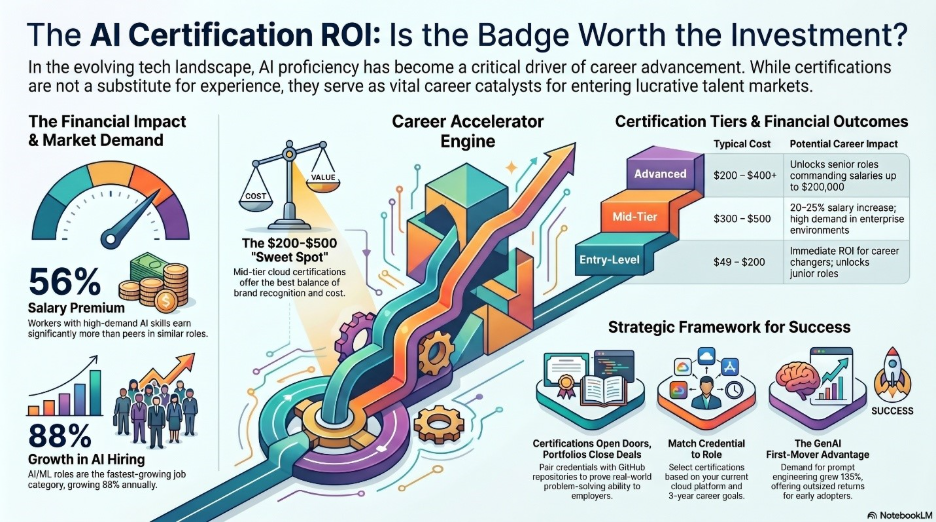
According to PwC's 2025 Global AI Jobs Barometer — drawn from close to a billion job postings across six continents — workers with high-demand AI skills now earn 56% more than colleagues in similar roles without those skills. The year before, that premium was 25%. In other words, the gap isn't shrinking; it's widening at an accelerating pace.
Lightcast's analysis of 1.3 billion job postings confirms this further: roles that explicitly require AI skills advertise a 28% salary premium, worth roughly $18,000 more per year. And professionals who stack multiple AI competencies can see premiums of up to 43%, according to the Oxford Internet Institute.
The hiring side of the equation is equally striking. AI/ML hiring grew 88% year-on-year in 2025, and LinkedIn ranked "Artificial Intelligence Engineer" as the single fastest-growing job category. Meanwhile, one in ten job postings now explicitly requires AI skills — a figure that has tripled since 2023.
In this landscape, AI certifications aren't just resume decorations. For many professionals, they are the most direct path to entering — or advancing within — one of the most lucrative talent markets in history.
What AI Certifications Actually Do (And Don't Do)
Here's where we at vThink like to slow down the hype and be precise about what a certification is, and what it isn't.
What certifications do well:
- Validate foundational knowledge in a standardized, employer-recognizable format
- Signal commitment — especially valuable when you're transitioning careers or lack years of AI-specific experience
- Open early hiring doors — recruiters screening hundreds of applications use certifications as a meaningful filter
- Provide structured learning — many of the best certifications (IBM, Google, AWS) are not just tests; they're guided learning experiences that build real skills
Pearson VUE's 2025 Value of IT Certification Candidate Report, based on nearly 24,000 IT professionals globally, found that 82% of respondents gained concrete career benefits after certification — including promotions, salary increases, and expanded responsibilities. That's not a marginal number.
What certifications don't replace:
Certifications are not a substitute for actual project experience, problem-solving ability, and domain judgment. Employers across the industry are consistent about this: a certificate alone won't get you the job. It will, however, get you the interview. Portfolios, GitHub repositories, and demonstrated real-world outcomes are what close the deal.
The honest picture is this — certifications and experience work best together, not as alternatives to each other.
The ROI Breakdown: Is the Math Worth It?
Let's look at this the way a software professional would: like an investment decision with real numbers.
Entry-level certifications (IBM AI Developer Professional Certificate, Google AI Essentials) typically cost $49–$200 and can be completed in weeks to a few months. The ROI is immediate for career changers. Real-world data documents professionals moving from $52,000 salaries into $78,000 junior ML engineering positions after completing these programs. If that jump happens in the first year, even a $200 certification pays for itself many times over in the first paycheck.
Mid-tier certifications (Microsoft Azure AI Engineer AI-102, AWS Certified AI Practitioner) cost $300–$500 and carry strong employer recognition in enterprise environments. Google and AWS certifications appeared in 40% more job postings than competing credentials in Q4 2025 through Q1 2026, with demand increasing 21% year-over-year. For professionals already working in tech, these credentials correlate with roughly a 20–25% salary bump.
Advanced certifications (Google Professional Machine Learning Engineer, AWS ML Specialty) require deep hands-on experience, cost $200–$400 in exam fees but months of preparation, and unlock roles commanding $130,000–$200,000+. Data engineers who add AI credentials through these programs command 25–35% salary premiums over traditional data engineering peers.
The cost-to-benefit sweet spot, according to most industry experts, sits in the $200–$500 range — credentials from major cloud providers that carry both brand recognition and practical skill validation.
What vThink Has Observed in Real Hiring Contexts
At vThink, we work with technology professionals across a range of roles — from software developers and data engineers to project managers and business analysts. Here's what we've observed firsthand in the hiring and upskilling process:
Certifications matter most at inflection points. If you're transitioning from a non-AI background, a recognized certification dramatically improves your chances of being considered for AI-adjacent roles. For senior professionals with deep project portfolios, certifications are a nice addition but rarely the deciding factor.
Employer-recognized names carry real weight. Certifications from AWS, Google, Microsoft, and IBM appear consistently in job descriptions because hiring managers trust these programs to signal a meaningful baseline. Niche or lesser-known certifications, regardless of their content quality, often don't translate the same way in automated screening.
Generative AI skills are in their own category right now. Demand for prompt engineering skills grew 135.8% in 2025. Generative AI expertise is associated with average salaries approaching $174,727. This is a niche where getting certified early — before the market normalizes — can yield outsized returns. The window of first-mover advantage in GenAI skills is still open, but narrowing.
Business and non-technical teams benefit too. The assumption that AI certifications are only for engineers is outdated. Andrew Ng's "AI for Everyone," Google AI Essentials, and the PMI AI+ certification (the first project management credential specifically for AI initiatives, launched in 2025) are designed for managers, product owners, and business strategists. Across industries, professionals who can bridge business context with AI literacy command significantly higher compensation than either domain alone.
The Hidden Value: Organizational Credibility and Team Capability
Beyond individual career outcomes, there's a business-level case for encouraging AI certification across your team — one that directly aligns with vThink's mission of driving meaningful technology adoption.
DigitalOcean's 2025 Currents report found that 79% of organizations now use AI, but 41% struggle to integrate it into existing workflows, 35% face challenges in model selection, and 30% navigate data privacy complexity. These are not technical problems alone — they are knowledge and literacy gaps at the organizational level.
When your team holds structured, validated AI knowledge, these gaps close faster. Certified professionals communicate more precisely with vendors, make more informed build-vs-buy decisions, and translate AI strategy into execution without the expensive trial-and-error that plagues organizations without that foundation.
The ROI of AI certification isn't just visible on individual W-2s. It shows up in faster project timelines, fewer costly architecture mistakes, and stronger competitive positioning.
How to Choose the Right AI Certification: A Framework
Given the hundreds of certifications now flooding the market, here's a practical decision framework we'd recommend at vThink:
1. Match the certification to your current role and next role — not to hype. If you're a cloud engineer on Azure, AI-102 makes more immediate sense than a Google Cloud credential, even if the latter has stronger brand recognition broadly.
2. Prioritize hands-on, production-grade programs. Certifications that include real labs, projects, and deployment scenarios build skills that survive interview scrutiny. Theory-only programs rarely do.
3. Don't buy a certification as a shortcut around experience. Attempting advanced certifications without the right foundations leads to expensive failure. Certifications should be layered onto experience, not used to substitute for it.
4. Think in 1-to-3 year career goals, not just the next job. The AI field is evolving fast — skills demanded by employers are changing 66% faster in AI-exposed occupations than in other roles. Choose certifications that build durable foundations (ML fundamentals, cloud AI architecture, MLOps) rather than chasing whichever tool is trending.
5. Pair your certification with a portfolio project. Certifications open doors; projects show you can walk through them. A GitHub repository demonstrating what you built with your new skills is worth more in an interview than the certification badge alone.
The vThink Verdict: Yes — With Precision
After reviewing the data and drawing on our own experience in software and AI integration, our view at vThink is clear: AI certifications are worth the investment — when chosen strategically.
The salary premiums are real and growing. The employer demand is verifiable and accelerating. The structured learning that comes with reputable programs builds skills that translate directly to business value. And for professionals at career inflection points — transitioning roles, entering AI for the first time, or leading AI transformation at an organizational level — a well-chosen certification can be genuinely life-changing.
But certifications are a catalyst, not a shortcut. They work best when layered onto real-world experience, combined with a portfolio of actual work, and chosen based on your specific career path rather than generic rankings.
At vThink, we believe that the most future-proof professionals are those who combine structured credential-building with continuous learning and practical application. The AI landscape isn't slowing down — and neither should your investment in staying relevant within it.