

7 AI Tools Every Marketing Team Should Be Using in 2026
Learn how marketing teams are using AI tools like ChatGPT, Claude, Perplexity, Canva AI, and Google Flow to work smarter and create content faster.

Marketing teams are creating more content than ever before.
A single campaign might require:
- Market research
- Content planning
- Blog articles
- Social media posts
- Visual creatives
- Videos
- Presentations
- Performance reporting
Traditionally, this could take days or even weeks.
Today, AI tools are helping marketing teams complete many of these tasks in hours instead of days.
The real value isn't in using a single AI tool.
It's in building a workflow where multiple AI tools work together.
Let's walk through a practical example.
Imagine your team wants to launch a campaign around "The Future of Work."
Here's how AI can support the entire process.
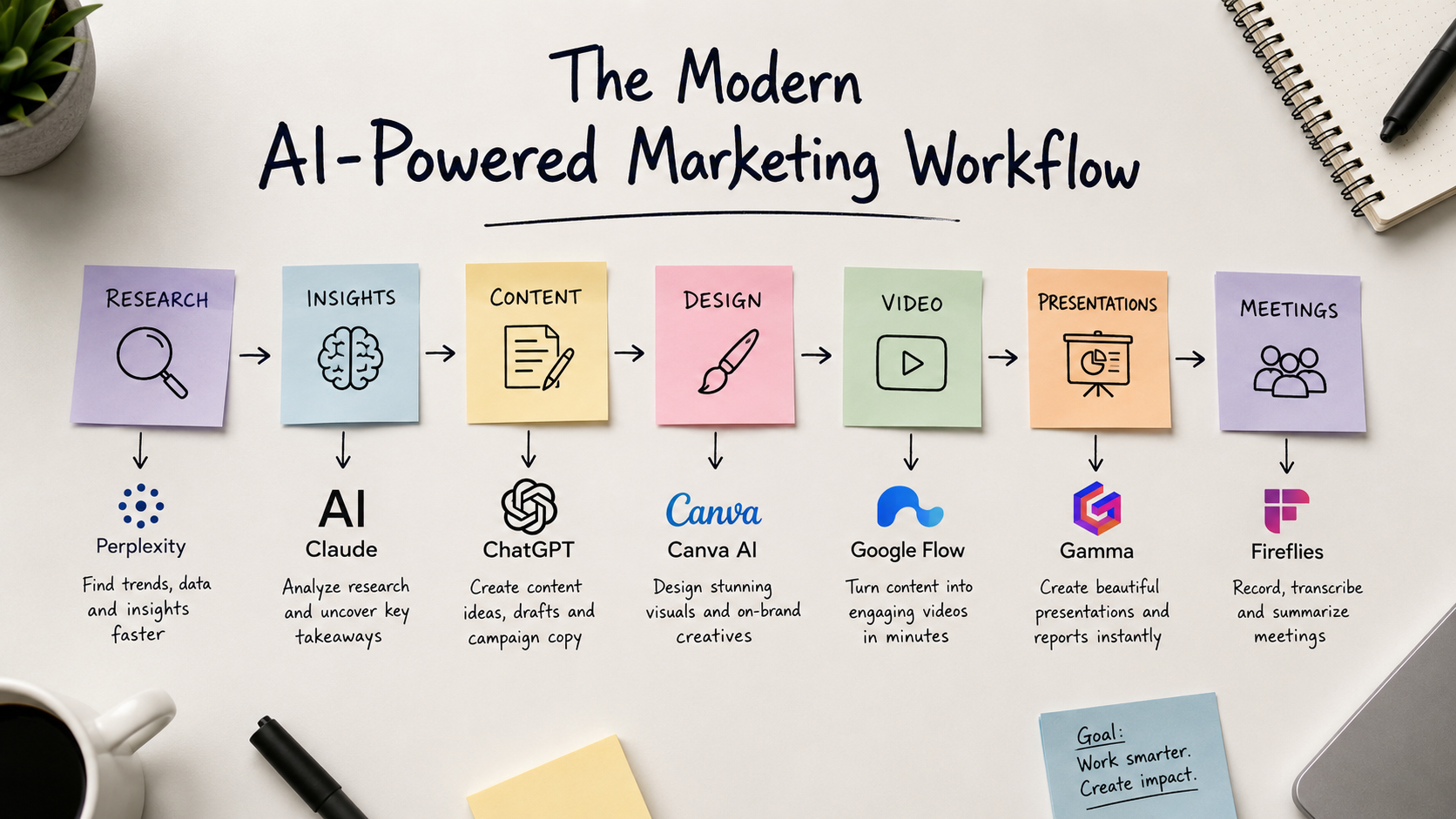
1. Perplexity – Start with Research
Every campaign begins with understanding the topic.
Instead of manually searching dozens of websites, marketers can use Perplexity to quickly gather:
- Industry trends
- Market statistics
- Research reports
- Competitor insights
- Expert opinions
For example:
Prompt:
"What are the latest workplace trends influenced by AI?"
Within minutes, you can collect data points, sources, and insights that would otherwise take hours to find.
2. Claude – Turn Research into Insights
Once research is collected, the next challenge is making sense of it.
This is where Claude shines.
Upload:
- Research reports
- Survey findings
- Customer feedback
- Competitor articles
Claude can identify:
- Common themes
- Emerging trends
- Key takeaways
- Content opportunities
Instead of reading a 50-page report, marketers can quickly understand the most important insights.
For example:
Upload:
- WEF Future of Jobs Report
- Microsoft Work Trend Index
Ask:
What are the top 5 insights marketing leaders should know?
Claude provides a structured summary that can be used to build campaigns and thought leadership content.
3. ChatGPT – Create the Content Plan
Once insights are identified, it's time to create content.
Marketing teams use ChatGPT for:
- Blog outlines
- Social media calendars
- Email campaigns
- Webinar ideas
- Lead magnet concepts
For example:
Prompt:
"Create a 30-day content plan around the future of work and AI."
Within seconds, ChatGPT generates content ideas that can be refined and customized.
4. Canva AI – Design Creative Assets
Now the campaign needs visuals.
Marketing teams can use Canva AI to create:
- Social media creatives
- LinkedIn carousels
- Infographics
- Event banners
- Blog graphics
For example:
A blog article can quickly become:
- A LinkedIn carousel
- An Instagram post
- A presentation slide
- A newsletter graphic
without requiring extensive design effort.
5. Google Flow – Turn Content into Video
Video continues to outperform most content formats.
After publishing a blog, marketers can use Google Flow to create:
- Product explainers
- Thought leadership videos
- Social media reels
- Campaign videos
For example:
A blog titled:
The Future of Work
can become:
- 60-second LinkedIn video
- Instagram Reel
- YouTube Short
- Full YouTube explainer
using the same source content.
This significantly increases content reach without starting from scratch.
6. Gamma – Create Presentations Instantly
Marketing teams constantly create presentations.
Examples:
- Quarterly reviews
- Campaign reports
- Client proposals
- Strategy decks
Instead of building slides manually, Gamma can convert content into presentation-ready decks within minutes.
This is especially useful for leadership updates and client-facing reports.
7. Fireflies – Capture Every Marketing Discussion
Campaign planning often happens in meetings.
Unfortunately, great ideas are frequently lost after the meeting ends.
Fireflies automatically records:
- Team discussions
- Client meetings
- Brainstorming sessions
and converts them into searchable summaries and action items.
This helps teams spend less time taking notes and more time executing.
Final Thoughts
The most effective marketing teams in 2026 won't be the ones using the most AI tools.
They'll be the teams that build efficient workflows around them.
AI won't replace marketers.
But marketers who know how to use AI effectively will have a significant advantage.
The goal isn't to automate creativity.
The goal is to spend less time on repetitive work and more time creating campaigns that drive real results.